Showing posts with label STEAM. Show all posts

Monday, February 29, 2016

Age estimating


For my Systems and Models course, we were assigned to design and conduct a sociological experiment and write a research paper, which had a minimum of 2,500 words. We were instructed to ask ourselves a question, state a hypothesis, design an experiment, conduct an experiment, gather data, and draw a logical conclusion. The purpose of this action project was to demonstrate the scientific method. We had to prepare a plan, which we used as a schedule to hold ourselves accountable of who, when, and where we will observe? How we will measure our observations? I chose to look at which gender is better at age guessing. I struggled with the planning of my experiment. I am proud of completing this action project.

Below is my research paper:


"TouchByte: Smart Technology: Intergrated Solutions. Web. 01 Mar. 2016


Wednesday, February 10, 2016

Hugging a Porcupine


Systems and Models is a STEAM course, in which we analyze people, systems, groups, and organizations from the inside out, outside in, and their interactions. We studied the psychological architecture within groups and people through observations and data analysis. For our first action project, we were assigned to create a self-portrait and write an artist statement. The purpose of this action project was to combine all of the information we learned about ourselves through the various psychological assessment activities and create an artistic rendering of ourselves. Our artist statement will explain our self-rendering. I experienced an artistic block, and combated it by surrounding myself with inspiration. I am proud of my artistic rendering.

Title: Hugging a Porcupine
Medium: Paper, Pen, and Pencil
Size: “6.5” inches by “9.5” inches


GN, "The Porcupine" 2016

In our class, we took a series of psychological assessments. A psychological assessment refers to a process of testing to help arrive at some hypotheses about a person and their personality, behavior or capabilities. The Myers-Briggs 16 personalities test was a major influence because it reaffirmed my beliefs in how I perceive the world and make decisions. The Myers-Briggs Type Indicator (MBTI) is an introspective self-report questionnaire that has become the golden standard of psychological assessments and a multi million dollar business because of its concept that everyone can fit into one of 16 personality types.

The MBTI reports tells you your preference for each of four pairs: Judging or Perceiving, Thinking or Feeling, Sensing or Intuition, and Extraversion or Introversion, these four preferences together make up your type. My results concluded that I was an ENTP-A (extremely, extroverted, intuitive, prospective, and thinking) personality type. This means that I am knowledgeable, energetic, argumentative, and insensitive. I am the ultimate devil’s advocate. I thrive on the process of shredding arguments for the simple reason that it's fun. My personality type can be perceived as vexing and my quarrelsome fun oftentimes inadvertently burns bridges.

In addition to the MBTI, I took several psychological assessments which reaffirmed my beliefs that I am a very direct, assertive, logical, and analytical individual. Through the Enneagram, which assesses motivations, I learned that I was an Eight (The challenger). Eights enjoy taking on challenges that gives them opportunities to exceed themselves in some way. Some famous Eights are Martin Luther King, J.r, Lyndon Johnson, and Saddam Hussein. We are motivated to be self-reliant, to prove our strength and resist weakness, to be important in my world, and to be in control of situations.

I wanted my art piece to reflect all of the qualities I was assessed with having. I did not want a cliche self portrait. Keeping the results in mind, I decided to draw a picture of a porcupine. Porcupines are small rodents with an over-abundance of attitude. I am prickly like the porcupine. According to the DiSC, an assessment tool used to improve teamwork, I am directive, assertive, confrontation, and analytical. I pay attention to the meaning of pattern of information I receive, I look at logical explanation to almost anything, and I tend to devalue the "people" (emotional) parts of situation. Porcupines have a coat of quills used against predators. My quills are my words. In our defense, our spikes are preemptive attacks to protect our own feelings. Because of our fear of vulnerability we have developed this armor. We are resourceful and fearless in the face of danger. The traits listed above are oftentimes viewed negatively and I can personally regulate the degree in which they are expressed.

We reviewed a couple of experiments such as the Marshmallow Experiment and the Stanford Prison Experiment. Me being goal-oriented was very instrumental when partaking in our class mini version of the Stanford Marshmallow Experiment. The Stanford Marshmallow Experiment was a series of studies on delayed gratification. We were offered a choice between one small, immediately reward of 1 marshmallow or 2 marshmallows if we waited for a approximately 20 minutes. I love challenging myself and waited for approximately 30 minutes.

The Stanford Prison Experiment was most intriguing to me because it showed that under certain circumstances people can be "evil". The Stanford Prison Experience was a study of the psychological implications of becoming a prisoner or prison guard. Based on the attributes accorded to me by the various assessment, if I was in a position of power such as the one designed in the Stanford Prison Experiment I would abuse such power. I am not an evil person. My characteristics are double-edge swords. As an Eight, I have to capacity to persuade others to follow in all kinds of endeavors from making peace to wagging war.

The last test we took in class was the TKI, which assesses how you deal with conflict. When dealing with conflict, my strongest strategies were competition and compromisation. My lowest score was an avoider, which means I never shy away from conflict. My results were competer (9), compromiser (8), problem solver (7), Avoider (5), and accommodator (1). I agree with these results because I have employed these conflict resolution styles in the past.

In order to glean an understanding on the art of writing artist statement, I interviewed my friend Linda, a local artist whose work has been featured in local coffee shops around the city. "An artist statement allows the artist to communicate their thought process to an audience. It is important to remember though that it isn't a space to dictate or sway your audience's viewpoint or feelings on the pieces." I kept her advice in mind during my writing process and creation of the piece. I want my piece to be left to interpretation. Everyone has a different perception of me but these perception are woven with a single thread; the Porcupine.


Work Cited:


  • Lillian Cunningham. "Myers-Briggs: Does It Pay to Know Your Type?"Washington Post. The Washington Post, 14 Dec. 2012. Web. 08 Feb. 2016. <https://www.washingtonpost.com/national/on-leadership/myers-briggs-does-it-pay-to-know-your-type/2012/12/14/eaed51ae-3fcc-11e2-bca3-aadc9b7e29c5_story.html>.
  •  "The Myers & Briggs Foundation - My MBTI® Results." The Myers & Briggs Foundation - My MBTI® Results. N.p., n.d. Web. 08 Feb. 2016. <http://www.myersbriggs.org/my-mbti-personality-type/my-mbti-results/>.
  •  "Porcupines, Porcupine Pictures, Porcupine Facts - National Geographic."National Geographic. N.p., n.d. Web. 08 Feb. 2016. <http://animals.nationalgeographic.com/animals/mammals/porcupine/>.
  • "Home." Stanford Prison Experiment. N.p., n.d. Web. 12 Feb. 2016. <http://www.prisonexp.org/>.
  •  "CPP - The People Development People." Thomas-Kilmann Conflict Mode Instrument (TKI). N.p., n.d. Web. 12 Feb. 2016. <https://www.cpp.com/products/tki/index.aspx>.
  •  JACOBA URIST. "What the Marshmallow Test Really Teaches About Self-Control." The Atlantic. Atlantic Media Company, 24 Sept. 2014. Web. 12 Feb. 2016. <http://www.theatlantic.com/health/archive/2014/09/what-the-marshmallow-test-really-teaches-about-self-control/380673/>.


Friday, October 23, 2015

Investing


For my STEAM course, Economics we were assigned to create an investment report that matched our investment objectives, risk tolerance, time horizon, and ethics. Our report was to be accompanied with explanations illustrating our investment decision-making reasoning, company research, data analysis (stocks, P/E, and our return on investments (RIO)), and understanding of the free market economy and its impact. The purpose of this action project was to reflect our understanding of the free market as indicated by the building of personal investment portfolio. I researched publicly-traded companies, created an investment portfolio, analyzed my investment decisions, tested my values and ethics when money is in the equation, and explained my decision making process and its intended and unintended consequences

I was gifted $50,556.80 by my guardian angel. Below is how I chose to invest the money.

An investment philosophy is a set of guiding principles that inform and shape an individual’s investment decision-making process. My investment philosophy is seeking relatively undervalued stocks and believing they will eventually produce strong returns, this is not to say I won’t invest in stocks that are already producing strong returns. I believe that looking at small changes in the market, diversifying and calculating systematically risk are the main predictors of my success of my investments.

Risk tolerance is an individual or investor's willingness to accept more risk in exchange for possibility of higher return. According to the Rutgers University’s Risk Tolerance Quiz, I have an above tolerance for risk. Investors with an above-average tolerance for risk are more likely to invest in securities, such as stocks in startup companies. An individual’s risk tolerance may vary according to goals, age, and needs. We were assigned to take an online risk tolerance survey, below are my results.

Below are my three theoretical financial goals I chose to work with for this project.
  • 1-year goal: Have a saving balance of $5,000 of spending money for my freshman year in college.
  • 5-year goal: I would like be away on a sabbatical, but have a saving balance of $35,000 of spending money to be able to leave comfortably for 1.5 year while backpacking through Europe. 
  • 25-year goal: I hope to own a house in San Francisco for about $1,895,000.

This project required me to test my values and ethics when money in the equation and to be able to explain my decision making and its intended and unintended consequences. In a narrow point of view the sole purpose of a business is to make money, the more the better. This viewpoint is conveniently embedded in our capitalist world. My only purpose in investing in these companies is to make a profit. I am well-aware that this may seem mercenary, but we are a money-oriented society. Contrary to popular beliefs, money is not the source of all evil. "Money is a ratio created in proportion to other things " said Nathan Aldinger, an ex-financial planner and Mubex (Mutually Beneficial Exchange startup company) CEO. Money is amoral, It doesn’t have guiding principles of its own, therefore it’s not evil. I will be investing in Google (Alphabet), Walt Disney, and Amazon. These corporations create profit and also builds social institutions.

PE ratio is the ratio of Principal to Earnings. So, what you invest is the numerator and what you get out is the denominator. The number is essentially how much you would have to invest to make $1.
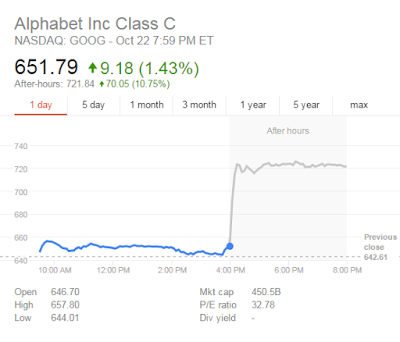
Alphabet Inc class C. 2015. Via Google.


- Google

Technology has revolutionized the way people work, communicate, and socialize with each other. It's only logical that I invest in Google stocks. Google has the cool factor working for it (driver-less cars, which have been spotted around California), and its very profitable YouTube business. Google stocks is a safe investment due to its dominance in the search and internet business. As of 2015, Google is worth $364.99 billion. Google is a formidable moat. A moat refers to how likely a company is to keep competitors away for an extended period. Google's continued popularity and relevance is particularly impressive given the rate of change and competition on the internet. Alphabet, google's parent corporation has a P/E of 34.86, compared to the industry which averages 20.24. Google is relatively a new in its field. Google does not pay dividends to its shareholders; it reinvest funds which increase the value of the corporation as a whole thus increasing the market value of the stock. I am willing to ride to ride out Google’s high P/E until it gets better.
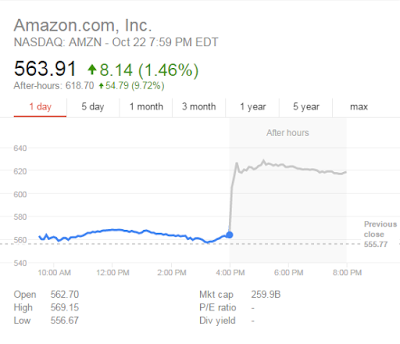
Amazon.com, Inc. 2015. Via Google.
- Amazon

Amazon is the Walmart online. Amazon is the online retailing king. In the past five years, the online retailer has seen iconic shares soar. Amazon's stock is up a staggering 460%, making it one of the best-performing widely held stocks available. Amazon has a huge growth, unequaled innovation, and Prime Revenue. The company's Amazon Prime membership service has helped propel sales. Amazon Prime is a service which I admittedly use that offers free two-day shipping, unlimited movie streaming, over 800,000 free eBooks, unlimited photo storage, and unlimited music streaming all at the cost of $99 a year. According to a report by Re/code, Mahaney estimated that the company has between 30 million and 40 million Prime subscribers in the U.S., and a total of 40 million to 50 million worldwide. Amazon's P/E ratio is 511.06 and doesn't pay any dividends.
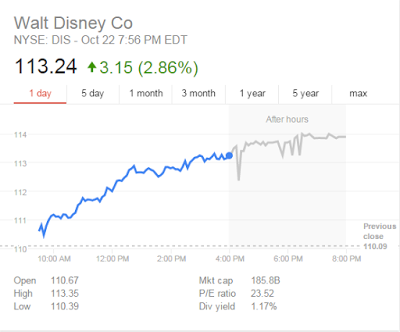
Walt Disney Co. 2015. Via Google.

- Walt Disney

I grew up loving Disney. Disney is a superpower in the entertainment industry, and has been on an impressive climb for the last years. Unlike some entertainment companies, Walt Disney has built a long-term viability. Much of this should be accredited to its aggressively strong branding. Disney's subsidiaries such as Pixar and Marvel also have powerful branding. Disney's ability to milk success, diversify revenue streams, cross-sell products are some of the reasons I decided to invest in its stocks. The recent dip in stock price have created a buying opportunity for me. Disney has a P/E ratio of 22.4 compared to its stock sector (entertainment) average of over 100. One area in which Disney isn't entertaining is in its dividends. Each stock share yields $0.66 per share. Disney's upcoming release schedule of Star Wars: Episode VII - The Force Awakens is predicted to be a very profitable event for the company.

A stock sector is the industry in which a business deals with. For my investments, I have branched into various different sectors. I diversified into different sectors to protect myself from shifts in particular industry that are possibly detrimental to my investments.

The time horizon is the time in which an investment is made or held before it is liquidated. It can range from seconds to decades. The time horizon depends on the investor’s individual objectives. The longer I wait the more profit I make. There isn’t a “right or wrong” time horizon. I have broken my investment into three portfolios, with additional details for each:

Portfolio I - 1 Year Goal

$3,000

2 shares of Google @ 693.34 (33% of portfolio)

9 shares of Disney @ 108.05 (66% of portfolio)

This grouping of Google and Disney has an expected ROI of 28.7%. After a year I should be able to have $5,000.

Portfolio II - 5 Years Goals


$20,000

26 shares of Amazon @ 560.31 (75% of portfolio)
46 shares of Disney @ 108.05 (25% of portfolio)

This grouping of Amazon and Disney has an expected ROI of 225.89%. I should be able to attain my goal of $35,000 for my trip.

Portfolio III - 25 Years Goals

$27,556.80

120 shares of Disney @ 108.05 (47% of the portfolio)
25 shares of Amazon @ 560.31 (52% of the portfolio)

This grouping of Amazon and Disney has an expected RIO of (340.6%. This gets me closer to achieving my goal of owning a house in San Francisco, the most expensive city in the United States as of now. San Francisco also gets me closer to my investments.

There are two main types of stock, common stocks and preferred stocks. Common stock or shares represent ownership in a company. The majority of stock is issued in this form. Not only do investors own a portion of the company, investors get 1 vote per share during the selection of the board members, the overseer of the major decision made. Preferred stocks is in some degrees a form of ownership, but this ownership is not accompanied with voting rights. Unlike like common stocks, which has variable dividends that are never guaranteed, with Preferred stocks, investors have a fixed dividend. All of the companies I will be investing in are common stocks. I prefer common stocks because they offer two ways for their owners to benefits, by capital gains and/or with dividends, and as the company becomes more valuable, so will the ownership interest represented by each shares of stock (this is the reason why don’t mind not getting dividends from Google or Amazon). 

I chose all of these companies because all of these companies in the long run would yield a profit.

Throughout my analysis, I have made numerous assumptions, which are:

  • - I assumed that Google, Disney,and Amazon will continue to be relevant. I believe that these companies are the driver of change in their industries creating a profit for its investors in the process. 
  • - Even after researching these companies, my entire strategy can fall apart if I sell at the wrong time. In the crisis of 2008, panic selling was a huge contributor to an already building crisis. Panic selling is a wide-scale selling of an investment which causes a sharp decline in prices. The ideal time to sell stock is when shares are overpriced relative to the value of the company. I am assuming that I will be able to ride out any obstacles. 
  • - I assume that the goals listed above hopefully would not change. 
I would still make the decisions I did in this project even I was given an opportunity to do otherwise. Investing is a great opportunity to make money.


Works Cited:


Wednesday, April 22, 2015

Triangular Bridge


For my Urban Planning course, we were assigned to build a functional bridge using Popsicle sticks, test our bridge against increasing loads, and analyze the results of the tests. In this unit we learned about the law of sines and cosines, vectors, and Newton's laws of motion. The purpose of this action project was to build a functional truss bridge that can sustain dynamic loads. I’m proud of the work I put into the bridge. I learned about the different types of bridges, such as the truss bridge and suspension bridge.

We were inspired by the Pratt Truss bridge design, which is a subcategory of a truss bridge. “A truss bridge is a bridge whose load-bearing superstructure is composed of a truss, a structure of connected elements forming triangular units” (WIKIPEDIA). The connected elements may experience stress from tension (the pulling force exerted by each end of a string/rod/cable etc) or/and compression (the pushing forces to different points on a structure or material).

The Standard Pratt Truss design uses right triangles, specifically with 90-45-45 degree angles. The Pratt Truss bridge is similar to the bridge below (90-45-45 degree angles):


Kgbo. "File:Gatton Railway Bridge.JPG." Commons.wikimedia. WikiMedia Commos, n.d. Web. 19 Apr. 2015.

After finding out that every group would be using equal amounts of materials to build a bridge, my teammate and I researched specific bridge designs already in use and common problems associated with bridges. Then, we drafted an accurate and well-thought-out plan before we started building our bridge. We decided to build a Pratt bridge because it had the most triangles. Triangles are the strongest geometrical shape because they spread the weight load to each of the sides. We started by putting the triangular truss system sides of the bridge together, then attaching the triangular truss system beam across so that we had the base. It was difficult to glue all the pieces together and the drying period was extremely long. We used clamps to hold the different pieces and glued them together. Our last step was attaching a few more Popsicle sticks across the trusses to add stability.

GN, Tension and compression diagram 2015.
TC, Bridge 2015.
TC, The blueprint of the Bridge 2015.

TC, Bridge 2015.
All of our Popsicle sticks were 4.5 inches long, and all of our triangles were 90-45-45 degree angles. “A Pratt truss is a simple truss structure with vertical compression (pushing together) members and diagonal tension (pulling apart) members” (The Balsawood Bridge). Our scale is 1 inch on the drawing = 3.5 inches in real life. The length of the blueprint bridge is 4 inches across (3.5 X 4 = 14 inches in real life). Our bridge was 5 inches tall and 4.5 inches wide. 


GN, Free Body diagram 2015
The Force of Gravity (mass x acceleration due to gravity) is pulling down, while the Normal Force is what counteracts that by pushing the bridge up.

Works Cited: 

Truss bridge. (2015, April 6). In Wikipedia, The Free Encyclopedia. Retrieved 01:27, April 20, 2015.

"The Balsawood Bridge." The Balsawood Bridge. N.p., n.d. Web. 19 Apr. 2015.


Thursday, March 5, 2015

Whole Foods' Guitar


For our second unit of Light and Sound, we learned about Sound and how it works. We were assigned to build a guitar out of recycled materials. The purpose of this action project was to use the knowledge we acquired and to create a functional guitar. I learned how the decibel scale (a logarithmic unit of measurement measuring the amplitude of a sound wave) works. I am proud of the research I did during external investigation.

GN, Drawing 2015
The main source of sound in a guitar is the string. When plucked, the strings vibrate. The vibrations travel through the saddle to the bridge to the soundboard, vibrating the soundboard. The form of the guitar is a hollow sound box which amplifies the vibrations. The frequencies produced can depend on the string length, tension, and diameter.

To make this guitar, I used a Whole Foods plastic bowl, two pieces of wood, hard cardboard, thumb tacks, and lots of glue! I put two thumb tacks through the hard cardboard, so that the rubber bands could be attached. I placed the two wood pieces and the hard cardboard across the bowl and glued it together as the neck of the guitar.


GN, Design 2015
GN, Guitar 2015

Since I used a rubber band, there are two strings you can pluck. Each one is 17.5 inches long. One open note is a F#4, with a frequency of 370 Hz and wavelength of 93.24 cm. The octave note is a Gb5 with a frequency of 740 Hz (370X2) and wavelength of 46.62 cm (93.24/2). The octave is the half way point of my string.

The thickness of the rubber band is about 0.59 mm. I used a bowl which had a radius of 3.5 inches. The formula for the volume of a cylinder is 4/3piR^3. This formula gives the volume of a complete sphere. In order to find the volume of the bowl I had to divide the volume of the sphere by two. The volume of the sphere was 179.59438 cubic inches (4/3 X pi X 3.5^3). The volume of the bowl was 89.79719 cubic inches (179.59438/2).

You can hear my guitar below.


The Doppler Effect is a phenomenon in which there is a change in frequency of a wave for an observer moving relative to its source, because as the source moves forward the sound waves are being pushed together resulting in a higher pitch.

My guitar could illustrate this concept if a guitarist were to walk and play; as he walks forward the sound wave will be pushed together resulting in a higher pitch sound to the observer/listeners, whereas if he/she were walking away the sound waves would be more spread apart and they would sound lower.

Vocabulary terms:
- Sound waves: Sound waves are longitudinal pressure waves by which sound is propagated (Online Dictionary).
- Frequency/pitch: The frequency is the number of cycles per second past a given point. Hertz is the unit measurement used for frequency.
- Amplitude: The amplitude is the displacement of a wave from its mean value (What Is Amplitude?). It is experienced as "loudness" or volume.
- Wavelength: The wavelength is the length of one complete wave cycle.


Work Cited:

Tuesday, February 10, 2015

Pringle Camera


Light and Sound is a course about how we see and hear the world and how we measure time. We were assigned to build, sketch, and explain how a pinhole camera works using STEAM principles. The purpose of this action project was to demonstrate our understanding of STEAM principles we studied which were refraction, wavelength, frequency, electromagnetic spectrum, and basic trigonometry. I am proud of my photo-gram picture, it is very modelesque!


Photo-Gram, GN 2015

A pinhole camera is a lightproof box with a tiny hole in one side. The tiny hole acts as the lens. The light rays from the sun enter into the tiny hole. They continue traveling until they hit the photo-sensitive paper. After it is exposed to light, the photo-sensitive paper is put into several chemicals which help develop the image that was created. This is why it is important that our box be completely lightproof.

Pinhole Camera Photo, GN 2015

This process illustrates how light is a particle. Light carries energy. The photo-sensitive paper reacts upon receiving photons (the quantum of light) especially visible light (electromagnetic spectrum). When photons heat the photo-sensitive paper, electrons get emitted from the surface. Only a particle can affect the quantum level of things. It also behaves like a wave because when two light rays come in contact, they don't bounce off of each other which would imply that light behaves as a particle. This doesn't illustrate refraction because refraction is the bending of light rays when they enter a transparent medium that slows its speed, whereas light travels straight through a pinhole.
.

Pinhole Camera, GN 2015

It's about 7 inches across from the lens to my photo paper. My toy person is about 11 inches tall. It's about 5.75 inches down from my pinhole to the bottom of my camera, so if I created similar triangles, the equation would be: 5.75 / 7 = 11 / X, where X is the distance between the back of my camera and the front of my toy. Since X = 13.391 (11 x 7 / 5.75) the minimum distance between my camera and my toy should be 13.391 - 7 = 6.391 inches.


Sketch, GN 2015


Using the Pythagorean theorem, I can calculate the hypotenuses of these triangles: 5.75^2 + 7^2 = (1)C^2, so (1)C = 9.05, and 13.39^2 + 11^2 = (2)C^2, (2)C = 17.328. 17.328 - 9.06 = 8.268. I can also use tan ^-1 of (5.75/7) to find the angle of the light hitting the back corner of my camera, which is 39.40 degrees. Since these are right triangles, the other angle is 180 degrees - 90 degrees - 39.40 degrees = 50.6 degrees.

My shutter speed (how long my lens was open) was 4 minutes. This didn't help much because my pinhole was so small, which didn't allow many light rays to enter. If I could do this over again, I would make a bigger pinhole to allow more light to go through.


Wednesday, December 17, 2014

3D Model of Blueprint - Stage Chemistry AP 2


In Stage Chemistry, we were assigned to build a 3D model of the theatre in our first Action Project (see the blueprints from Unit 1, here). We were assigned to play the role of a set designer, also known as the scenic designer. The scenic designer established an overall visual concept for the production and design the stage environment. We had to incorporate the scale and proportions determined in Unit 1, add working miniatures to demonstrate motion that will occur on stage, and an explanation of how & why the elements in our 3D model optimizes our adaptation. The purpose of this action project was to build a 3D model. I learned how to build stairs with the help of JR.

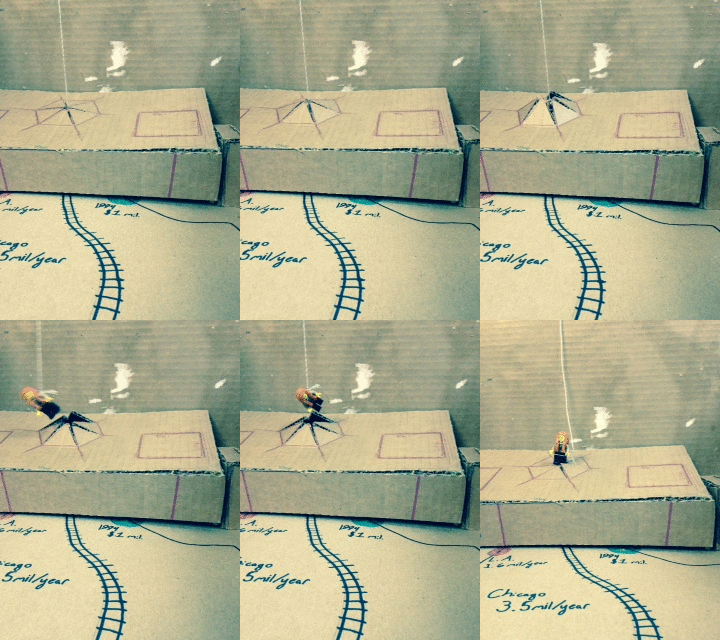
The stage has been set with a functioning star trap style door, and a rotating scenery flats.

Areal view of stage. GN, 2014
Stage. GN, 2014

Stage. GN, 2014


Rotary Scenery Flats:
The adaptation is split into three important locations in the story - Scrooge's residence, graveyard, Scrooge's business. Any other scenes will take place without the scenery on the stage. It would either be projected or very reliant on props. 
Inspired by Aaron Moring-D'angier's equilateral triangular prism, I too constructed an equilateral triangular prism that is made of three 3'x8' flats attached on the sides. The triangular prism rests on a raked based, which accounts for the raked stage. The rotary scenery would be moved mechanically by a computer. It would already be programmed in terms of the time at which the prism will rotate. I thought that having an actor or someone physically move it would pose a risk I was not willing to take (perfect timing would of been an issue).  

GN, with the help of Aaron Moring-D'angier


Star Trap: 

In theatre, a trap is a concealed opening usually in the stage floor. Traps are used to create a great variety of stage effects, such as the sudden appearance and disappearance of characters or objects on stage. There are many types of traps. The star trap is a circular opening with lids composed of wedge-shaped sections individually hinged to the circumference. 

GN, with the help of Aaron Moring-D'angier


Trap Safety Protocols: 
  • Prepared yourself (timing) 
  • Make sure the wedge-shaped section functions properly
  • Stabilize yourself after going through the star trap

Works Cited: 


Tuesday, November 25, 2014

The Blueprint - A Stage Chemistry


In my Stage Chemistry course, which is a course about learning the production process of theatre and how learning about theatre production changes your perception and experience of the world. This course has come to exist through the partnership with The Goodman Theatre in Chicago. For our first action project, we were assigned to pick a place, adapt that place into a theatre and create a blueprint for it. The purpose of this action project was to create a blueprint of our theatre and use logic and mathematics to justify the decisions we made along the way. I learned how to use conditional statements. A conditional statement is a If-then statement (a logical connector). Even though, this project required tedious work, I enjoyed working on this project. I am proud of the drawings on my blueprint.

Below is my blueprint, and my reflection.


The Fassaes Theatre Blueprint


The Monomonee Club is a not-for profit boys and girls club that help children have fun by offering a variety of recreational programs. The building is located downtown and is near nice restaurants and other theatres such as the IO and the Steppenwolf Theatre. It also has a large parking lot. I chose the Fassaes studio in the Menomonee building because I had easy access to it. Conveniently enough, the Fassaes studio also had many of the theatrical components I wanted in my theatre, such as a lighting system and the sound quality. Since people already attend the Monomonee Club I would already have a customer source. I encountered a lot of problems measuring, but I solved it by collaborating with other classmates.


Thursday, October 23, 2014

Aluminum Cans


BKJ (Earth), 2014


Humans throw so much away with so little thought as to where that trash is going and how it affects us in the future. In my Design and Engineering course, we were assigned to collect samples of a product that was being wasted and assemble the samples into a visual representation of an issue. The purpose of this action project was to create something that represents and illustrates a global issue we are facing: material waste. Our waste material was aluminum, particularly aluminum cans. I learned and appreciate trial and error and I am proud of the way my partner and I worked together.

A beverage can is a metal container designed to hold a fixed portion of liquid such as carbonated soft drinks, alcoholic beverages, fruit juices, teas, herbal teas, energy drinks, etc. Beverage cans are made of aluminum (75% of worldwide production) or tin-plated steel (25% worldwide production)(Wikipedia).

Aluminum is a slippery-white metal and the second most abundant metallic element in the earth's crust. It weighs about 1/3 as much as steel, and is remarkable for its excellent corrosion resistance, durability, ability to be easily machined or cast and its volumetric mass density (density) (Wikipedia). Some of the uses for aluminum are in electrical transmission, packaging, and transportation.

Here are some interesting facts about aluminum waste from Lehighcounty: 
  • It takes about 80-200 years for an aluminum can to biodegrade.
  • In 2012, 55 percent of aluminum beer and soft drink containers generated were recycled, which is about 0.7 million tons.
  • The largest source of aluminum in the MSW (municipal solid waste) stream is used beverage containers and other packaging containers.
  • There is no limit to the amount of times aluminum can be recycled. 
  • It is estimated that over the past twenty years, we've trashed more than 11 million tons of aluminum beverage cans worth over $12 billion on today's market.
  • Americans throw away enough aluminum every three months to rebuild our entire commercial air fleet.
"Liquid Candy: How Softdrinks Are Harming America's Health ~ CSPI." Liquid Candy: How Softdrinks Are Harming America's Health ~ CSPI. N.p., n.d. Web. 23 Oct. 2014. 

Our installation shows a model earth made almost entirely out of aluminum beverage cans, glue, strings, and a Styrofoam ball as our base. Our installation depicts a model earth with silver representing water, green and brown representing earth. The strings represents how many times the total number of aluminum cans wasted in 2012 would go around the earth. There are 5 string around our earth installation, each string represents 7385.285408 times the number of cans goes around the earth. This piece was inspired by the amount of soda cans our school wastes each year, which is roughly about 29,850 aluminum cans. On average, a person will use 597 cans of soda pop each year.

BKJ and GN (Earth), 2014

BKJ and GN (Earth), 2014
Logistics for cans used in our installation:
2 Diet coca cola cans
7 Root beer cans
4 Sprite cans
1 Coca cola cans
1 Sparking water can
* All of our materials comes from either staffs or students from GCE (Global Citizenship Experience).

Calculations: 
On average each American drinks 597 cans of soda a year. The average life expectancy of an American in 2012 was about 78 years (World Bank). This means that over a lifetime, an American would drink 46566 cans of soda. In 2012, the United States population was 312,780,968 (US. News). Number of aluminum cans of soda drank in 2012: 312,780,968 x 46566 = 1.456495856e13 (14,564,958,560,000 cans).

Amount of times the number of aluminum cans went around earth calculations: 
- Earth's circumference: 24,901 miles.
- Conversion to miles/space: 14,564,958,560,000 cans x 4 (height of a can) x 12 ft/5280 = 919504959.6 miles
- Number of times United States' waste of 2012 goes around the earth: 919504959.6 miles/24,901 miles (circumference of earth) = 36926.42704 times.

Recycling is an important part of a sustainable lifestyle and is a solution to this aluminum waste problem. It’s important for the future of the planet that we all live sustainably. Recycling aluminum saves an enormous amount of energy, because the aluminum is already in its metallic state. Recycling was a low-profile activity until the late 1960's when the growing use of aluminum cans brought it to the public's attention.

Here are some facts about the importance of recycling aluminum:
  • Tossing away an aluminum can wastes as much energy as pouring out half of that can's volume of gasoline.
  • Recycling one aluminum can saves enough energy to run a TV for three hours, this is the equivalent of a half a gallon of gasoline.
  • Making beverage cans from recycled aluminum cuts air pollution by about 95%.
  • The pollutants created in producing one ton of aluminum include 3,290 pounds of red mud, 2,900 pounds of carbon dioxide (a greenhouse gas), 81 pounds of air pollutants and 789 pounds of solid wastes.

Works Cited:

  1. "Aluminum Recycling Facts." Aluminum Recycling Facts. N.p., n.d. Web. 21 Oct. 2014.
  2. "Aluminum, Common Wastes & Materials." EPA. Environmental Protection Agency, n.d. Web. 21 Oct. 2014. 
  3. Aluminium. (2014, October 15). In Wikipedia, The Free Encyclopedia. Retrieved 02:47, October 24, 2014.
  4. "Chemical of the Week -- Aluminum." Chemical of the Week -- Aluminum. N.p., n.d. Web. 23 Oct. 2014. 
  5. "Aluminum Statistics and Information." USGS Minerals Information: Aluminum. N.p., n.d. Web. 23 Oct. 2014. 
  6. "Liquid Candy: How Softdrinks Are Harming America's Health ~ CSPI." Liquid Candy: How Softdrinks Are Harming America's Health ~ CSPI. N.p., n.d. Web. 23 Oct. 2014.
  7. Robert Schlesinger. "U.S. Population 2012: Nearly 313 Million People." US News. U.S.News & World Report, 30 Dec. 2011. Web. 26 Oct. 2014. 
  8. "Life Expectancy at Birth, Total (years)." Data. N.p., n.d. Web. 26 Oct. 2014.


Friday, October 10, 2014

Designed With The User In Mind


SJ, The Diamond Bike 2014

In my Design and Engineering course, we were assigned to brainstorm ideas with our partners to design a reliable bicycle that suits a specific user’s needs. We sketched our three strongest ideas and built a prototype. The purpose of this action project is to create a better bicycle for a particular user. I learned to harness empathy (understand and share the feelings of another) to do things better, and appreciate trial and error. I am proud of completing this project on time, given the deadline.
We were assigned to design a bike for Vanessa, a 17 year old high school student who lives in Oak Park. Vanessa travels a total amount of 9 miles from home to school. She has a baby brother, whom she drops off at daycare everyday. She rides down Lake street, which is a noisy (given the fact that it is under a train track) and busy street filled with potholes. Her apartment has no storage room, so she has to lock her bike outside everyday.

After many ideas and complications my partner and I came up with the Diamond Bike. Its main purposes are safety, durability, maneuverability, speed, and a baby carrier. Although the Diamond Bike was designed specially for Vanessa, there is no reason why it cannot be used or adopted for other demographics.

GN, The 3D Model 2014


The Diamond Bike features:

  • Detachable Baby bassinet 
The stroller is detachable, so that the user has a choice of either detaching the stroller or keeping it once they are done using it. There’s a twist type lock that’s a part of the frame.

AJ, Main Feature 2015
  •  Built In frame U-lock 
In the top tube of the bike frame, there are two U-locks at the end of each side. The two U-locks are extendable, and are used to lock up the two wheels by them interlocking.
  •  Detachable U-lock handlebar
We were inspired by the Denny bike made by Teague and Sizemore Bicycle, to create our own U-lock handlebar that locks the frame.


AJ, U-lock Frame 2014
  •  Pneumatic tires with small iron pins
We were inspired by Schwalbe, Marathon winter tires, which have small iron pins that gives the user full control on icy roads. Pneumatic (containing or operated by air or gas under pressure) tires help reduce the effect of bumps.
  • Light signals
A lot of cyclist worry about their safety, the Diamond Bike has a lighting system attached above the breaks, that allows the user to signal the driver behind them that they will be making a turn. There are two turning signals, a left turning signal and a right turning signal.
  •  Motion detectors 
Our bike is safer than other bikes with our sensor in the back. The sensor will beep whenever a car is coming up fast behind, to alert the user.
  •  Triangular frame
The Diamond Bike has a triangular/wedge bike frame which allows the weight of the bike to be equally distributed. For light weightiness, The Diamond Bike is made out of aluminum.
  •  Comfortable seat
The Diamond Bike has extra cushion on the bike seat for comfort while riding long or short distances.

Calculations

Distance: 9 miles
Diameter: 26 inches
Circumference: (D x pi) 26 x pi = 81.68 inches
Speed: (Distance/Time) 9mi/50min = 10.8 mph or 4.827 m/s
Wheel Rotations: (Distance/Circumference) 6,981.39 rotations in 9 miles.

P.S. The scale used is for our 3D model is a 13 inches, meaning for every 3 inches in our model equals 13 inches in real life. The diameter of the wheels in our model is 2 inches and in real life they are 26 inches.    
                 
In conclusion, when investing in a bike you expect it to be suitable to your needs, "A good bike should pay itself off" said Joey a bike repairer. The Diamond Bike doesn't just cater to the spectrum of people with children, but other consumers that value safety, sturdiness, and easy mobility. The Diamond Bike is not only a form of transportation, but a way of life!

Tuesday, September 16, 2014

The Evolution a Wheelbarrow


Design and Engineering is a STEM (science, technology, engineering, mathematics) course that focuses on building things well: user-friendly, and sustainable. For our first action project, we were assigned to use physics concepts to sketch an easier to use gardening tool for senior citizens. My partner and I chose to redesign a wheelbarrow. I learned to harness empathy (understand and share the feelings of another) to do things better, and appreciate trial and error.

The Gucci Wheelbarrow

GN (2014)

Vectors
GN (2014)

Storyboard:


GN (2014)

GN (2014)

Gardening is a fun outdoor activity, as the spare time provides exercise, and has various therapeutic qualities. Stephanie Leite believes that "It is just satisfying I think, to see what grows. It's totally unpredictable." There is no reason why a lifelong love of gardening should end as mobility and other limitations arise in senior citizens. Adaptive garden tools, allow senior citizens to continue to pursue their love of gardening. The Gucci Wheelbarrow is an adaptive tool that my partner and I have designed.

A wheelbarrow consists of an inclined plane, lever (handles), axle, and wheels. The wheelbarrow’s handles extend the length of the wheelbarrow and acts as a lever. A lever is a rigid bar resting on a pivot at a fixed hinge, called a fulcrum. The axle, raised up by the wheels, acts as the fulcrum point.

Many wheelbarrow manufacturers emphasize comfort in the grip handles and weight to minimize the force and energy needed to push the wheelbarrow, both in the visual design and in the production descriptions. The more expensive wheelbarrows differentiate themselves by their high quality materials, in the tray, handles, and wheels. The Gucci Wheelbarrow emphasizes high quality, affordability, comfort, and minimization of force and energy used while using the item.

Unlike other wheelbarrow manufacturers, the Gucci Wheelbarrow specifically favors the need of senior citizens. Our design affords strength and stability with the double T-bar handle, which allows the user to maneuver the heaviest load lightly and comfortably. It also permits greater control of deposition of the load on emptying. The Gucci Wheelbarrow handle is designed to keep elbows tucked while using the wheelbarrow, which reduces the strain on the user's shoulders. It also has a spongy rubber sleeve over the T-bar handle to increase grip, therefore reducing the strain on the user's knuckles and joints.

Although, the two-wheeled wheelbarrows are more stable, and the one wheeled wheelbarrows are more maneuverable, the Gucci Wheelbarrow design has managed to blur the line between the one and two wheeled wheelbarrows. The T-bar handle allows the Gucci Wheelbarrow to be more maneuverable and the two low-ground flat free tires make the Gucci Wheelbarrow more stable. One feature that make the Gucci Wheelbarrow special is our lever release system and push or pull handle. The lever release system allows to content/things in the wheelbarrow tray to be easily dumped. The push or pull handle gives the user the option of either pulling or pushing the wheelbarrow.

In conclusion, the Gucci Wheelbarrow design keeps in mind the physical restrictions of senior citizens and accommodates to their needs and limitation.
Works Cited:

"OXO Good Grips." Smart Design. N.p., n.d. Web. 17 Sept. 2014. <http://smartdesignworldwide.com/work/oxo-good-grips/>.

"Protecting Your Joints When You're Gardening." Arthritis Research UK. N.p., n.d. Web. 17 Sept. 2014. <http://www.arthritisresearchuk.org/arthritis-information/arthritis-and-daily-life/gardening-and-arthritis/protecting-your-joints.aspx>.

"Effects of Aging -OrthoInfo - AAOS." Effects of Aging -OrthoInfo - AAOS. N.p., n.d. Web. 17 Sept. 2014. <http://orthoinfo.aaos.org/topic.cfm?topic=A00191>.