Showing posts with label 3D Model. Show all posts

Wednesday, April 22, 2015

Triangular Bridge


For my Urban Planning course, we were assigned to build a functional bridge using Popsicle sticks, test our bridge against increasing loads, and analyze the results of the tests. In this unit we learned about the law of sines and cosines, vectors, and Newton's laws of motion. The purpose of this action project was to build a functional truss bridge that can sustain dynamic loads. I’m proud of the work I put into the bridge. I learned about the different types of bridges, such as the truss bridge and suspension bridge.

We were inspired by the Pratt Truss bridge design, which is a subcategory of a truss bridge. “A truss bridge is a bridge whose load-bearing superstructure is composed of a truss, a structure of connected elements forming triangular units” (WIKIPEDIA). The connected elements may experience stress from tension (the pulling force exerted by each end of a string/rod/cable etc) or/and compression (the pushing forces to different points on a structure or material).

The Standard Pratt Truss design uses right triangles, specifically with 90-45-45 degree angles. The Pratt Truss bridge is similar to the bridge below (90-45-45 degree angles):


Kgbo. "File:Gatton Railway Bridge.JPG." Commons.wikimedia. WikiMedia Commos, n.d. Web. 19 Apr. 2015.

After finding out that every group would be using equal amounts of materials to build a bridge, my teammate and I researched specific bridge designs already in use and common problems associated with bridges. Then, we drafted an accurate and well-thought-out plan before we started building our bridge. We decided to build a Pratt bridge because it had the most triangles. Triangles are the strongest geometrical shape because they spread the weight load to each of the sides. We started by putting the triangular truss system sides of the bridge together, then attaching the triangular truss system beam across so that we had the base. It was difficult to glue all the pieces together and the drying period was extremely long. We used clamps to hold the different pieces and glued them together. Our last step was attaching a few more Popsicle sticks across the trusses to add stability.

GN, Tension and compression diagram 2015.
TC, Bridge 2015.
TC, The blueprint of the Bridge 2015.

TC, Bridge 2015.
All of our Popsicle sticks were 4.5 inches long, and all of our triangles were 90-45-45 degree angles. “A Pratt truss is a simple truss structure with vertical compression (pushing together) members and diagonal tension (pulling apart) members” (The Balsawood Bridge). Our scale is 1 inch on the drawing = 3.5 inches in real life. The length of the blueprint bridge is 4 inches across (3.5 X 4 = 14 inches in real life). Our bridge was 5 inches tall and 4.5 inches wide. 


GN, Free Body diagram 2015
The Force of Gravity (mass x acceleration due to gravity) is pulling down, while the Normal Force is what counteracts that by pushing the bridge up.

Works Cited: 

Truss bridge. (2015, April 6). In Wikipedia, The Free Encyclopedia. Retrieved 01:27, April 20, 2015.

"The Balsawood Bridge." The Balsawood Bridge. N.p., n.d. Web. 19 Apr. 2015.


Thursday, March 5, 2015

Whole Foods' Guitar


For our second unit of Light and Sound, we learned about Sound and how it works. We were assigned to build a guitar out of recycled materials. The purpose of this action project was to use the knowledge we acquired and to create a functional guitar. I learned how the decibel scale (a logarithmic unit of measurement measuring the amplitude of a sound wave) works. I am proud of the research I did during external investigation.

GN, Drawing 2015
The main source of sound in a guitar is the string. When plucked, the strings vibrate. The vibrations travel through the saddle to the bridge to the soundboard, vibrating the soundboard. The form of the guitar is a hollow sound box which amplifies the vibrations. The frequencies produced can depend on the string length, tension, and diameter.

To make this guitar, I used a Whole Foods plastic bowl, two pieces of wood, hard cardboard, thumb tacks, and lots of glue! I put two thumb tacks through the hard cardboard, so that the rubber bands could be attached. I placed the two wood pieces and the hard cardboard across the bowl and glued it together as the neck of the guitar.


GN, Design 2015
GN, Guitar 2015

Since I used a rubber band, there are two strings you can pluck. Each one is 17.5 inches long. One open note is a F#4, with a frequency of 370 Hz and wavelength of 93.24 cm. The octave note is a Gb5 with a frequency of 740 Hz (370X2) and wavelength of 46.62 cm (93.24/2). The octave is the half way point of my string.

The thickness of the rubber band is about 0.59 mm. I used a bowl which had a radius of 3.5 inches. The formula for the volume of a cylinder is 4/3piR^3. This formula gives the volume of a complete sphere. In order to find the volume of the bowl I had to divide the volume of the sphere by two. The volume of the sphere was 179.59438 cubic inches (4/3 X pi X 3.5^3). The volume of the bowl was 89.79719 cubic inches (179.59438/2).

You can hear my guitar below.


The Doppler Effect is a phenomenon in which there is a change in frequency of a wave for an observer moving relative to its source, because as the source moves forward the sound waves are being pushed together resulting in a higher pitch.

My guitar could illustrate this concept if a guitarist were to walk and play; as he walks forward the sound wave will be pushed together resulting in a higher pitch sound to the observer/listeners, whereas if he/she were walking away the sound waves would be more spread apart and they would sound lower.

Vocabulary terms:
- Sound waves: Sound waves are longitudinal pressure waves by which sound is propagated (Online Dictionary).
- Frequency/pitch: The frequency is the number of cycles per second past a given point. Hertz is the unit measurement used for frequency.
- Amplitude: The amplitude is the displacement of a wave from its mean value (What Is Amplitude?). It is experienced as "loudness" or volume.
- Wavelength: The wavelength is the length of one complete wave cycle.


Work Cited:

Tuesday, February 10, 2015

Pringle Camera


Light and Sound is a course about how we see and hear the world and how we measure time. We were assigned to build, sketch, and explain how a pinhole camera works using STEAM principles. The purpose of this action project was to demonstrate our understanding of STEAM principles we studied which were refraction, wavelength, frequency, electromagnetic spectrum, and basic trigonometry. I am proud of my photo-gram picture, it is very modelesque!


Photo-Gram, GN 2015

A pinhole camera is a lightproof box with a tiny hole in one side. The tiny hole acts as the lens. The light rays from the sun enter into the tiny hole. They continue traveling until they hit the photo-sensitive paper. After it is exposed to light, the photo-sensitive paper is put into several chemicals which help develop the image that was created. This is why it is important that our box be completely lightproof.

Pinhole Camera Photo, GN 2015

This process illustrates how light is a particle. Light carries energy. The photo-sensitive paper reacts upon receiving photons (the quantum of light) especially visible light (electromagnetic spectrum). When photons heat the photo-sensitive paper, electrons get emitted from the surface. Only a particle can affect the quantum level of things. It also behaves like a wave because when two light rays come in contact, they don't bounce off of each other which would imply that light behaves as a particle. This doesn't illustrate refraction because refraction is the bending of light rays when they enter a transparent medium that slows its speed, whereas light travels straight through a pinhole.
.

Pinhole Camera, GN 2015

It's about 7 inches across from the lens to my photo paper. My toy person is about 11 inches tall. It's about 5.75 inches down from my pinhole to the bottom of my camera, so if I created similar triangles, the equation would be: 5.75 / 7 = 11 / X, where X is the distance between the back of my camera and the front of my toy. Since X = 13.391 (11 x 7 / 5.75) the minimum distance between my camera and my toy should be 13.391 - 7 = 6.391 inches.


Sketch, GN 2015


Using the Pythagorean theorem, I can calculate the hypotenuses of these triangles: 5.75^2 + 7^2 = (1)C^2, so (1)C = 9.05, and 13.39^2 + 11^2 = (2)C^2, (2)C = 17.328. 17.328 - 9.06 = 8.268. I can also use tan ^-1 of (5.75/7) to find the angle of the light hitting the back corner of my camera, which is 39.40 degrees. Since these are right triangles, the other angle is 180 degrees - 90 degrees - 39.40 degrees = 50.6 degrees.

My shutter speed (how long my lens was open) was 4 minutes. This didn't help much because my pinhole was so small, which didn't allow many light rays to enter. If I could do this over again, I would make a bigger pinhole to allow more light to go through.


Wednesday, December 17, 2014

3D Model of Blueprint - Stage Chemistry AP 2


In Stage Chemistry, we were assigned to build a 3D model of the theatre in our first Action Project (see the blueprints from Unit 1, here). We were assigned to play the role of a set designer, also known as the scenic designer. The scenic designer established an overall visual concept for the production and design the stage environment. We had to incorporate the scale and proportions determined in Unit 1, add working miniatures to demonstrate motion that will occur on stage, and an explanation of how & why the elements in our 3D model optimizes our adaptation. The purpose of this action project was to build a 3D model. I learned how to build stairs with the help of JR.

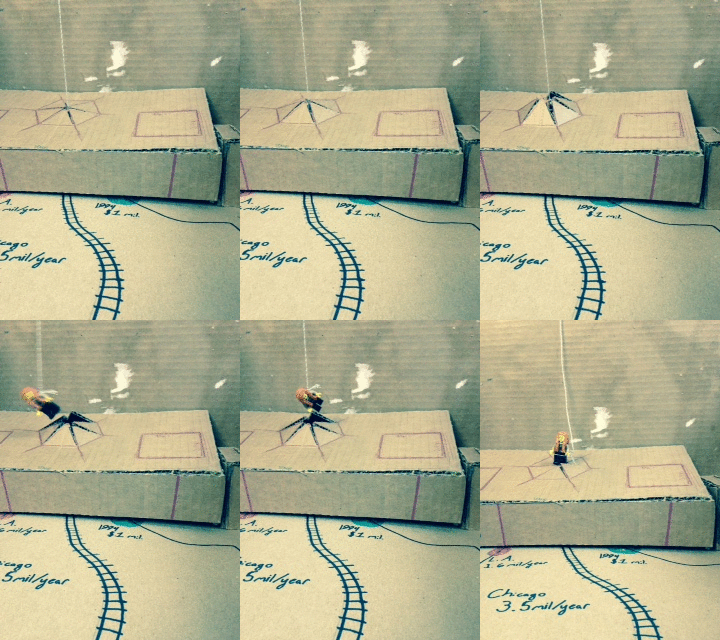
The stage has been set with a functioning star trap style door, and a rotating scenery flats.

Areal view of stage. GN, 2014
Stage. GN, 2014

Stage. GN, 2014


Rotary Scenery Flats:
The adaptation is split into three important locations in the story - Scrooge's residence, graveyard, Scrooge's business. Any other scenes will take place without the scenery on the stage. It would either be projected or very reliant on props. 
Inspired by Aaron Moring-D'angier's equilateral triangular prism, I too constructed an equilateral triangular prism that is made of three 3'x8' flats attached on the sides. The triangular prism rests on a raked based, which accounts for the raked stage. The rotary scenery would be moved mechanically by a computer. It would already be programmed in terms of the time at which the prism will rotate. I thought that having an actor or someone physically move it would pose a risk I was not willing to take (perfect timing would of been an issue).  

GN, with the help of Aaron Moring-D'angier


Star Trap: 

In theatre, a trap is a concealed opening usually in the stage floor. Traps are used to create a great variety of stage effects, such as the sudden appearance and disappearance of characters or objects on stage. There are many types of traps. The star trap is a circular opening with lids composed of wedge-shaped sections individually hinged to the circumference. 

GN, with the help of Aaron Moring-D'angier


Trap Safety Protocols: 
  • Prepared yourself (timing) 
  • Make sure the wedge-shaped section functions properly
  • Stabilize yourself after going through the star trap

Works Cited: 


Thursday, October 23, 2014

Aluminum Cans


BKJ (Earth), 2014


Humans throw so much away with so little thought as to where that trash is going and how it affects us in the future. In my Design and Engineering course, we were assigned to collect samples of a product that was being wasted and assemble the samples into a visual representation of an issue. The purpose of this action project was to create something that represents and illustrates a global issue we are facing: material waste. Our waste material was aluminum, particularly aluminum cans. I learned and appreciate trial and error and I am proud of the way my partner and I worked together.

A beverage can is a metal container designed to hold a fixed portion of liquid such as carbonated soft drinks, alcoholic beverages, fruit juices, teas, herbal teas, energy drinks, etc. Beverage cans are made of aluminum (75% of worldwide production) or tin-plated steel (25% worldwide production)(Wikipedia).

Aluminum is a slippery-white metal and the second most abundant metallic element in the earth's crust. It weighs about 1/3 as much as steel, and is remarkable for its excellent corrosion resistance, durability, ability to be easily machined or cast and its volumetric mass density (density) (Wikipedia). Some of the uses for aluminum are in electrical transmission, packaging, and transportation.

Here are some interesting facts about aluminum waste from Lehighcounty: 
  • It takes about 80-200 years for an aluminum can to biodegrade.
  • In 2012, 55 percent of aluminum beer and soft drink containers generated were recycled, which is about 0.7 million tons.
  • The largest source of aluminum in the MSW (municipal solid waste) stream is used beverage containers and other packaging containers.
  • There is no limit to the amount of times aluminum can be recycled. 
  • It is estimated that over the past twenty years, we've trashed more than 11 million tons of aluminum beverage cans worth over $12 billion on today's market.
  • Americans throw away enough aluminum every three months to rebuild our entire commercial air fleet.
"Liquid Candy: How Softdrinks Are Harming America's Health ~ CSPI." Liquid Candy: How Softdrinks Are Harming America's Health ~ CSPI. N.p., n.d. Web. 23 Oct. 2014. 

Our installation shows a model earth made almost entirely out of aluminum beverage cans, glue, strings, and a Styrofoam ball as our base. Our installation depicts a model earth with silver representing water, green and brown representing earth. The strings represents how many times the total number of aluminum cans wasted in 2012 would go around the earth. There are 5 string around our earth installation, each string represents 7385.285408 times the number of cans goes around the earth. This piece was inspired by the amount of soda cans our school wastes each year, which is roughly about 29,850 aluminum cans. On average, a person will use 597 cans of soda pop each year.

BKJ and GN (Earth), 2014

BKJ and GN (Earth), 2014
Logistics for cans used in our installation:
2 Diet coca cola cans
7 Root beer cans
4 Sprite cans
1 Coca cola cans
1 Sparking water can
* All of our materials comes from either staffs or students from GCE (Global Citizenship Experience).

Calculations: 
On average each American drinks 597 cans of soda a year. The average life expectancy of an American in 2012 was about 78 years (World Bank). This means that over a lifetime, an American would drink 46566 cans of soda. In 2012, the United States population was 312,780,968 (US. News). Number of aluminum cans of soda drank in 2012: 312,780,968 x 46566 = 1.456495856e13 (14,564,958,560,000 cans).

Amount of times the number of aluminum cans went around earth calculations: 
- Earth's circumference: 24,901 miles.
- Conversion to miles/space: 14,564,958,560,000 cans x 4 (height of a can) x 12 ft/5280 = 919504959.6 miles
- Number of times United States' waste of 2012 goes around the earth: 919504959.6 miles/24,901 miles (circumference of earth) = 36926.42704 times.

Recycling is an important part of a sustainable lifestyle and is a solution to this aluminum waste problem. It’s important for the future of the planet that we all live sustainably. Recycling aluminum saves an enormous amount of energy, because the aluminum is already in its metallic state. Recycling was a low-profile activity until the late 1960's when the growing use of aluminum cans brought it to the public's attention.

Here are some facts about the importance of recycling aluminum:
  • Tossing away an aluminum can wastes as much energy as pouring out half of that can's volume of gasoline.
  • Recycling one aluminum can saves enough energy to run a TV for three hours, this is the equivalent of a half a gallon of gasoline.
  • Making beverage cans from recycled aluminum cuts air pollution by about 95%.
  • The pollutants created in producing one ton of aluminum include 3,290 pounds of red mud, 2,900 pounds of carbon dioxide (a greenhouse gas), 81 pounds of air pollutants and 789 pounds of solid wastes.

Works Cited:

  1. "Aluminum Recycling Facts." Aluminum Recycling Facts. N.p., n.d. Web. 21 Oct. 2014.
  2. "Aluminum, Common Wastes & Materials." EPA. Environmental Protection Agency, n.d. Web. 21 Oct. 2014. 
  3. Aluminium. (2014, October 15). In Wikipedia, The Free Encyclopedia. Retrieved 02:47, October 24, 2014.
  4. "Chemical of the Week -- Aluminum." Chemical of the Week -- Aluminum. N.p., n.d. Web. 23 Oct. 2014. 
  5. "Aluminum Statistics and Information." USGS Minerals Information: Aluminum. N.p., n.d. Web. 23 Oct. 2014. 
  6. "Liquid Candy: How Softdrinks Are Harming America's Health ~ CSPI." Liquid Candy: How Softdrinks Are Harming America's Health ~ CSPI. N.p., n.d. Web. 23 Oct. 2014.
  7. Robert Schlesinger. "U.S. Population 2012: Nearly 313 Million People." US News. U.S.News & World Report, 30 Dec. 2011. Web. 26 Oct. 2014. 
  8. "Life Expectancy at Birth, Total (years)." Data. N.p., n.d. Web. 26 Oct. 2014.


Friday, October 10, 2014

Designed With The User In Mind


SJ, The Diamond Bike 2014

In my Design and Engineering course, we were assigned to brainstorm ideas with our partners to design a reliable bicycle that suits a specific user’s needs. We sketched our three strongest ideas and built a prototype. The purpose of this action project is to create a better bicycle for a particular user. I learned to harness empathy (understand and share the feelings of another) to do things better, and appreciate trial and error. I am proud of completing this project on time, given the deadline.
We were assigned to design a bike for Vanessa, a 17 year old high school student who lives in Oak Park. Vanessa travels a total amount of 9 miles from home to school. She has a baby brother, whom she drops off at daycare everyday. She rides down Lake street, which is a noisy (given the fact that it is under a train track) and busy street filled with potholes. Her apartment has no storage room, so she has to lock her bike outside everyday.

After many ideas and complications my partner and I came up with the Diamond Bike. Its main purposes are safety, durability, maneuverability, speed, and a baby carrier. Although the Diamond Bike was designed specially for Vanessa, there is no reason why it cannot be used or adopted for other demographics.

GN, The 3D Model 2014


The Diamond Bike features:

  • Detachable Baby bassinet 
The stroller is detachable, so that the user has a choice of either detaching the stroller or keeping it once they are done using it. There’s a twist type lock that’s a part of the frame.

AJ, Main Feature 2015
  •  Built In frame U-lock 
In the top tube of the bike frame, there are two U-locks at the end of each side. The two U-locks are extendable, and are used to lock up the two wheels by them interlocking.
  •  Detachable U-lock handlebar
We were inspired by the Denny bike made by Teague and Sizemore Bicycle, to create our own U-lock handlebar that locks the frame.


AJ, U-lock Frame 2014
  •  Pneumatic tires with small iron pins
We were inspired by Schwalbe, Marathon winter tires, which have small iron pins that gives the user full control on icy roads. Pneumatic (containing or operated by air or gas under pressure) tires help reduce the effect of bumps.
  • Light signals
A lot of cyclist worry about their safety, the Diamond Bike has a lighting system attached above the breaks, that allows the user to signal the driver behind them that they will be making a turn. There are two turning signals, a left turning signal and a right turning signal.
  •  Motion detectors 
Our bike is safer than other bikes with our sensor in the back. The sensor will beep whenever a car is coming up fast behind, to alert the user.
  •  Triangular frame
The Diamond Bike has a triangular/wedge bike frame which allows the weight of the bike to be equally distributed. For light weightiness, The Diamond Bike is made out of aluminum.
  •  Comfortable seat
The Diamond Bike has extra cushion on the bike seat for comfort while riding long or short distances.

Calculations

Distance: 9 miles
Diameter: 26 inches
Circumference: (D x pi) 26 x pi = 81.68 inches
Speed: (Distance/Time) 9mi/50min = 10.8 mph or 4.827 m/s
Wheel Rotations: (Distance/Circumference) 6,981.39 rotations in 9 miles.

P.S. The scale used is for our 3D model is a 13 inches, meaning for every 3 inches in our model equals 13 inches in real life. The diameter of the wheels in our model is 2 inches and in real life they are 26 inches.    
                 
In conclusion, when investing in a bike you expect it to be suitable to your needs, "A good bike should pay itself off" said Joey a bike repairer. The Diamond Bike doesn't just cater to the spectrum of people with children, but other consumers that value safety, sturdiness, and easy mobility. The Diamond Bike is not only a form of transportation, but a way of life!