Friday, October 23, 2015

Investing


For my STEAM course, Economics we were assigned to create an investment report that matched our investment objectives, risk tolerance, time horizon, and ethics. Our report was to be accompanied with explanations illustrating our investment decision-making reasoning, company research, data analysis (stocks, P/E, and our return on investments (RIO)), and understanding of the free market economy and its impact. The purpose of this action project was to reflect our understanding of the free market as indicated by the building of personal investment portfolio. I researched publicly-traded companies, created an investment portfolio, analyzed my investment decisions, tested my values and ethics when money is in the equation, and explained my decision making process and its intended and unintended consequences

I was gifted $50,556.80 by my guardian angel. Below is how I chose to invest the money.

An investment philosophy is a set of guiding principles that inform and shape an individual’s investment decision-making process. My investment philosophy is seeking relatively undervalued stocks and believing they will eventually produce strong returns, this is not to say I won’t invest in stocks that are already producing strong returns. I believe that looking at small changes in the market, diversifying and calculating systematically risk are the main predictors of my success of my investments.

Risk tolerance is an individual or investor's willingness to accept more risk in exchange for possibility of higher return. According to the Rutgers University’s Risk Tolerance Quiz, I have an above tolerance for risk. Investors with an above-average tolerance for risk are more likely to invest in securities, such as stocks in startup companies. An individual’s risk tolerance may vary according to goals, age, and needs. We were assigned to take an online risk tolerance survey, below are my results.

Below are my three theoretical financial goals I chose to work with for this project.
  • 1-year goal: Have a saving balance of $5,000 of spending money for my freshman year in college.
  • 5-year goal: I would like be away on a sabbatical, but have a saving balance of $35,000 of spending money to be able to leave comfortably for 1.5 year while backpacking through Europe. 
  • 25-year goal: I hope to own a house in San Francisco for about $1,895,000.

This project required me to test my values and ethics when money in the equation and to be able to explain my decision making and its intended and unintended consequences. In a narrow point of view the sole purpose of a business is to make money, the more the better. This viewpoint is conveniently embedded in our capitalist world. My only purpose in investing in these companies is to make a profit. I am well-aware that this may seem mercenary, but we are a money-oriented society. Contrary to popular beliefs, money is not the source of all evil. "Money is a ratio created in proportion to other things " said Nathan Aldinger, an ex-financial planner and Mubex (Mutually Beneficial Exchange startup company) CEO. Money is amoral, It doesn’t have guiding principles of its own, therefore it’s not evil. I will be investing in Google (Alphabet), Walt Disney, and Amazon. These corporations create profit and also builds social institutions.

PE ratio is the ratio of Principal to Earnings. So, what you invest is the numerator and what you get out is the denominator. The number is essentially how much you would have to invest to make $1.
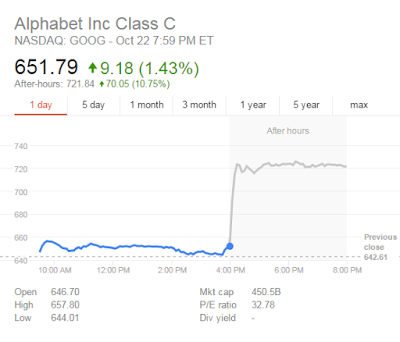
Alphabet Inc class C. 2015. Via Google.


- Google

Technology has revolutionized the way people work, communicate, and socialize with each other. It's only logical that I invest in Google stocks. Google has the cool factor working for it (driver-less cars, which have been spotted around California), and its very profitable YouTube business. Google stocks is a safe investment due to its dominance in the search and internet business. As of 2015, Google is worth $364.99 billion. Google is a formidable moat. A moat refers to how likely a company is to keep competitors away for an extended period. Google's continued popularity and relevance is particularly impressive given the rate of change and competition on the internet. Alphabet, google's parent corporation has a P/E of 34.86, compared to the industry which averages 20.24. Google is relatively a new in its field. Google does not pay dividends to its shareholders; it reinvest funds which increase the value of the corporation as a whole thus increasing the market value of the stock. I am willing to ride to ride out Google’s high P/E until it gets better.
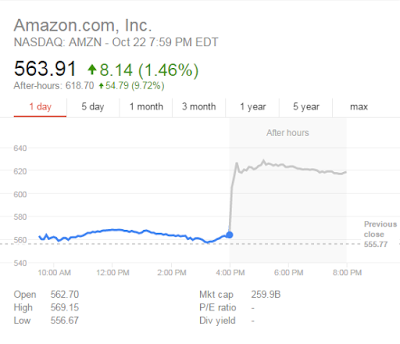
Amazon.com, Inc. 2015. Via Google.
- Amazon

Amazon is the Walmart online. Amazon is the online retailing king. In the past five years, the online retailer has seen iconic shares soar. Amazon's stock is up a staggering 460%, making it one of the best-performing widely held stocks available. Amazon has a huge growth, unequaled innovation, and Prime Revenue. The company's Amazon Prime membership service has helped propel sales. Amazon Prime is a service which I admittedly use that offers free two-day shipping, unlimited movie streaming, over 800,000 free eBooks, unlimited photo storage, and unlimited music streaming all at the cost of $99 a year. According to a report by Re/code, Mahaney estimated that the company has between 30 million and 40 million Prime subscribers in the U.S., and a total of 40 million to 50 million worldwide. Amazon's P/E ratio is 511.06 and doesn't pay any dividends.
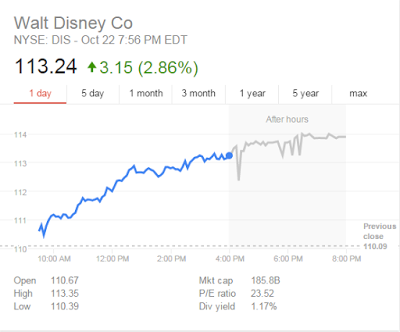
Walt Disney Co. 2015. Via Google.

- Walt Disney

I grew up loving Disney. Disney is a superpower in the entertainment industry, and has been on an impressive climb for the last years. Unlike some entertainment companies, Walt Disney has built a long-term viability. Much of this should be accredited to its aggressively strong branding. Disney's subsidiaries such as Pixar and Marvel also have powerful branding. Disney's ability to milk success, diversify revenue streams, cross-sell products are some of the reasons I decided to invest in its stocks. The recent dip in stock price have created a buying opportunity for me. Disney has a P/E ratio of 22.4 compared to its stock sector (entertainment) average of over 100. One area in which Disney isn't entertaining is in its dividends. Each stock share yields $0.66 per share. Disney's upcoming release schedule of Star Wars: Episode VII - The Force Awakens is predicted to be a very profitable event for the company.

A stock sector is the industry in which a business deals with. For my investments, I have branched into various different sectors. I diversified into different sectors to protect myself from shifts in particular industry that are possibly detrimental to my investments.

The time horizon is the time in which an investment is made or held before it is liquidated. It can range from seconds to decades. The time horizon depends on the investor’s individual objectives. The longer I wait the more profit I make. There isn’t a “right or wrong” time horizon. I have broken my investment into three portfolios, with additional details for each:

Portfolio I - 1 Year Goal

$3,000

2 shares of Google @ 693.34 (33% of portfolio)

9 shares of Disney @ 108.05 (66% of portfolio)

This grouping of Google and Disney has an expected ROI of 28.7%. After a year I should be able to have $5,000.

Portfolio II - 5 Years Goals


$20,000

26 shares of Amazon @ 560.31 (75% of portfolio)
46 shares of Disney @ 108.05 (25% of portfolio)

This grouping of Amazon and Disney has an expected ROI of 225.89%. I should be able to attain my goal of $35,000 for my trip.

Portfolio III - 25 Years Goals

$27,556.80

120 shares of Disney @ 108.05 (47% of the portfolio)
25 shares of Amazon @ 560.31 (52% of the portfolio)

This grouping of Amazon and Disney has an expected RIO of (340.6%. This gets me closer to achieving my goal of owning a house in San Francisco, the most expensive city in the United States as of now. San Francisco also gets me closer to my investments.

There are two main types of stock, common stocks and preferred stocks. Common stock or shares represent ownership in a company. The majority of stock is issued in this form. Not only do investors own a portion of the company, investors get 1 vote per share during the selection of the board members, the overseer of the major decision made. Preferred stocks is in some degrees a form of ownership, but this ownership is not accompanied with voting rights. Unlike like common stocks, which has variable dividends that are never guaranteed, with Preferred stocks, investors have a fixed dividend. All of the companies I will be investing in are common stocks. I prefer common stocks because they offer two ways for their owners to benefits, by capital gains and/or with dividends, and as the company becomes more valuable, so will the ownership interest represented by each shares of stock (this is the reason why don’t mind not getting dividends from Google or Amazon). 

I chose all of these companies because all of these companies in the long run would yield a profit.

Throughout my analysis, I have made numerous assumptions, which are:

  • - I assumed that Google, Disney,and Amazon will continue to be relevant. I believe that these companies are the driver of change in their industries creating a profit for its investors in the process. 
  • - Even after researching these companies, my entire strategy can fall apart if I sell at the wrong time. In the crisis of 2008, panic selling was a huge contributor to an already building crisis. Panic selling is a wide-scale selling of an investment which causes a sharp decline in prices. The ideal time to sell stock is when shares are overpriced relative to the value of the company. I am assuming that I will be able to ride out any obstacles. 
  • - I assume that the goals listed above hopefully would not change. 
I would still make the decisions I did in this project even I was given an opportunity to do otherwise. Investing is a great opportunity to make money.


Works Cited:


Saturday, October 17, 2015

The Ghost of Coco Chanel


For my Journalism course, we were assigned to create a podcast about a voice important to the 21st century. The purpose of this action project was to produce a podcast that told a story of an important voice, using the concepts and skills of radio-journalism. For this action project, I chose to represent Coco Chanel's voice. I have always loved fashion and wanted to know more about its history. We were asked to create a mini-biography of "this voice". I drafted a script, researched her story, collected/recorded interviews, and selected sound-effects and soundtracks to create a podcast. I enjoyed preparing my voice using various warm up activities. I am proud of how the project came all together. I used a software called audacity to edit my podcast. I was very nervous going diving into the project because I am not very good at editing, but after scheduling multiple meetings with tech savvy teachers, I was able to get a better handle on it. I struggle with completing my reverse transcript. Below is my podcast and reverse transcript.


Wednesday, May 13, 2015

"Just" War

CNN. "Special Report: Who Are The Yazidis, And Why Does ISIS Want To Kill Them? (PHOTOS) - The Trent." The Trent. N.p., 12 Aug. 2014. Web. 13 May 2015. 

For my Policy course, we were assigned to select a war to focus on, research policies and (executive) orders related to that war, and write an analytical essay arguing whether that war was “right” or “wrong”. The purpose of this action project was to take a specific position on whether the U.S involvement in a specific war was justified or not. This action project is particularly difficult on an ethical ground because Is there a difference between a “right” war and a “wrong” war? How do we distinguish between the two? Is there such a thing as a “just” war? The merriam-webster defines just as having a basis in or conforming to fact or reason, acting or being in conformity with what is morally upright or good, righteous, and legally correct.

The majority of people believe that killing, fighting, and war is wrong, but might agree that in some situations it is necessary. When is war just? Philosophers, statesmen, and justices have grappled with this question for centuries, beginning with the first Mesopotamians to the Greeks (History of the world, Wiki). “The just war theory or the jus ad bellum is a doctrine, also referred to as a tradition, of military ethics studied by theologians, ethicists, policymakers, and military leaders (just war theory, Wiki). The just war theory has become basis for international agreements like the Geneva Convention and modern humanitarian laws. The Geneva Convention of 1864 was the first treaty concerning humanitarian aid in wartime. It extensively defined the basic rights of wartime prisoners, established protection for the wounded, and established protections for civilians in and around a war-zone (Wiki).

According to the “just war theory”, was America justified in declaring war on Japan and subsequently on Germany and Italy? This essay will attempt to prove that the U.S involvement in World War 2 was a just one. On Friday September 1, 1939, Germany invaded Poland which marked the start of World war 2. The global war lasted from 1939 to 1945, it involved the majority of the world’s nations, including all the great powers. WW2 formed two opposing military alliances: the Allies and the Axis. Germany, Italy, Japan were the Axis. The U.S, Britain, France, Australia, China, and the Soviet Union were the Allies.

The jus ad bellum sets forth 6 requirements, all of which must be met for a war to be considered “just”. Using 2 requirements set forth by jus ad bellum, I will attempt to prove that the U.S. involvement in World War 2 war just.
  • Just cause. “Just cause is first and foremost the self-defense of a nation that is physically and aggressively attacked by another nation”(). “Although the war began with Nazi Germany’s attack on Poland in September 1939, the United states did not enter the war until after the Japanese bombed the American fleet in Pearl Harbor, Hawaii, on December 7, 1941” (World war 2). Almost at the same time, Japanese airplanes attack two U.S islands: Wake and Guam, which were later occupied. In December 08, 1940, President Franklin D. Roosevelt declared war on Japan. The United States exhausted all plausible and peaceful alternatives to resolve the conflict in question. In an effort to remain neutral, In July 1940 the U.S cuts off oil exports to Japan after Japanese troops began to occupy the French colony of Indochina (National Geographic). In September 1940, Germany, Italy, and Japan signed a treaty (the Tripartite Pact) that made the three countries allies against England and France (National Geographic). The treaty is seen as a warning to the U.S to stop helping England and France, because the U.S had traded 50 old destroyers to England in exchange for naval and air bases in the Western Hemisphere (National Geographic). By July 1940, Germany had invaded Norway, Denmark, Netherlands, Belgium, Luxembourg, and conquered France. The United States was physically and aggressively attacked by Japan, thus abiding to the just cause requirements of the jus ad bellum. 
  • Right intentions. The nation that wages war must do so for the right motives, that is, just to ensure that the just cause is attained by war’s end. The U.S entrance in World war 2 was motivated by morally rational motives. “Hitler's germany was extending totalitarianism, racism, militarism, and overt aggressive warfare beyond what an already cynical world had experienced,” (World War II: A People's War? - Howard Zinn). World war 2 was a war against an enemy of unspeakable evil. Universal goods expected to result from of the war was proportional to the cost the war proceeded. 

Though, the U.S entrance in the war and the WW2 itself was just, our country’s wartime policies, and treatment of minorities at home casted shadows on that principle. Franklin D. Roosevelt converted America’s economy into a military economy and the unemployment problem ended with the mobilization for war. FDR took part in the Atlantic Charter, and executive actions, but Congress had it’s own agenda. Congress passed the Lend-Leases Act. “The act authorized the president to transfer arms or any other defense materials for which Congress appropriated money to “the government of any country whose defense the President deems vital to the defense of the United States” (History).

In a WW2 espionage scare frenzy, President Franklin D. Roosevelt, encouraged by officials at all levels of the federal government authorized the internment American citizens of Japanese ancestry and resident aliens from Japan (Historymatters). Roosevelt’s executive order 9066, ‘“authorized the evacuation of all persons deemed a threat to national security from the West Coast to relocation centers further inland,” (Archives.gov). Executive order 9066 was unconstitutional and discriminative. Executive order 9066 went against the Bills of rights and violated a U.S law: the incarceration of U.S citizens without due process of the law. The executive order fueled hatred and prejudice towards Japanese Americans and went against the law. In 1988, President Jimmy Carter issued a $20,000 reparation to each surviving internee.

War’s controversial social effects raises troubling ethical/moral question for any thoughtful person, yet it remains central to social changes and human history which seems extremely paradoxical. I am not certain if anything makes a war "just" but the just war theory is a way in which we can make sure that a war is justified.


Works Cited:

Wednesday, April 22, 2015

Triangular Bridge


For my Urban Planning course, we were assigned to build a functional bridge using Popsicle sticks, test our bridge against increasing loads, and analyze the results of the tests. In this unit we learned about the law of sines and cosines, vectors, and Newton's laws of motion. The purpose of this action project was to build a functional truss bridge that can sustain dynamic loads. I’m proud of the work I put into the bridge. I learned about the different types of bridges, such as the truss bridge and suspension bridge.

We were inspired by the Pratt Truss bridge design, which is a subcategory of a truss bridge. “A truss bridge is a bridge whose load-bearing superstructure is composed of a truss, a structure of connected elements forming triangular units” (WIKIPEDIA). The connected elements may experience stress from tension (the pulling force exerted by each end of a string/rod/cable etc) or/and compression (the pushing forces to different points on a structure or material).

The Standard Pratt Truss design uses right triangles, specifically with 90-45-45 degree angles. The Pratt Truss bridge is similar to the bridge below (90-45-45 degree angles):


Kgbo. "File:Gatton Railway Bridge.JPG." Commons.wikimedia. WikiMedia Commos, n.d. Web. 19 Apr. 2015.

After finding out that every group would be using equal amounts of materials to build a bridge, my teammate and I researched specific bridge designs already in use and common problems associated with bridges. Then, we drafted an accurate and well-thought-out plan before we started building our bridge. We decided to build a Pratt bridge because it had the most triangles. Triangles are the strongest geometrical shape because they spread the weight load to each of the sides. We started by putting the triangular truss system sides of the bridge together, then attaching the triangular truss system beam across so that we had the base. It was difficult to glue all the pieces together and the drying period was extremely long. We used clamps to hold the different pieces and glued them together. Our last step was attaching a few more Popsicle sticks across the trusses to add stability.

GN, Tension and compression diagram 2015.
TC, Bridge 2015.
TC, The blueprint of the Bridge 2015.

TC, Bridge 2015.
All of our Popsicle sticks were 4.5 inches long, and all of our triangles were 90-45-45 degree angles. “A Pratt truss is a simple truss structure with vertical compression (pushing together) members and diagonal tension (pulling apart) members” (The Balsawood Bridge). Our scale is 1 inch on the drawing = 3.5 inches in real life. The length of the blueprint bridge is 4 inches across (3.5 X 4 = 14 inches in real life). Our bridge was 5 inches tall and 4.5 inches wide. 


GN, Free Body diagram 2015
The Force of Gravity (mass x acceleration due to gravity) is pulling down, while the Normal Force is what counteracts that by pushing the bridge up.

Works Cited: 

Truss bridge. (2015, April 6). In Wikipedia, The Free Encyclopedia. Retrieved 01:27, April 20, 2015.

"The Balsawood Bridge." The Balsawood Bridge. N.p., n.d. Web. 19 Apr. 2015.


Wednesday, March 11, 2015

How the Grinch Fixed the Code of Conduct?

For my Argument Course, we were assigned to create an amendment to the GCE Code of Conduct, defending a necessary change in rules based upon your evaluation of its logical flaws. The purpose of this action project was to construct an argument to amend the Code of Conduct. I learned about the different fallacies. Below is my argument.


The idea in these equations is to sum all the forces on it and set them equal to ma. The interesting thing is how the equations tie together changes in all the different stress components, making them interdependent on each other, which is the same idea I wanted to introduce in my argument, this idea of equilibrium/equality. You would assume that a document that plays a major role in students'life wouldn't lacks their voices, but it does. "Equilibrium." Equilibrium. N.p., n.d. Web. 12 Mar. 2015.

Schools have been writing Codes of Conduct for decades, but the role they play in shaping students’ behavior has changed dramatically. “The Code of Conduct is a set of rules outlining the responsibilities of, or proper practices for, an individual, party or organization” (Wikipedia). These Codes of Conduct must be followed by students and are in effect during, after and school-related activities. The primary reason for a Code of Conduct is to maintain standards of an institution and set forth procedures necessary to protect and keep a learning environment.

I have crafted the following amendment to provide an alternative to the students’ contract for the Code of Conduct. This amendment rectifies the agreement portion of the Code of Conduct and allows students, including those who are new, to get a chance to discuss and modify the Code of Conduct before blindly agreeing to it. This amendment also states students’ rights, which shall not be denied or abridged by the Disciplinary council.

Preamble:

This amendment is committed to safeguarding the rights given to all students under the state and federal law and incorporating the students’ voice in a document that greatly affects them. In addition to providing civic/cognitive/emotional development and a safe school environment, all students have the right to:

Note: Many of the students’ rights include examples. The examples included are not intended to be the only things covered by the rights. The examples covered in the definition are included, but the definition/right is not limited to the examples given.

  • 1. Have an equal chance to take part in any activities regardless of color, race, religious affiliations, gender, sexual orientation, disability, or class rank. 
  • 2. Access to school rules and if necessary receives an explanation of those rules from staff. Staff includes, teachers, the disciplinary council, and counselors. 
  • 3. Freedom of speech/expression provided that such right does not cause any disorder or disruption within the school. “Freedom of expression is the right of every individual to hold opinions without interference” (Wikipedia). This includes without limitations the right to express those views through speech, symbolism, and writing. I am fully aware that this portion of the students’ rights contradicts that of the Dress Code, which reads as follow “Clothing may not advocate or promote acts of violence, self-destruction, alcohol and drug consumption, racism, xenophobia, religious intolerance, sexual or promiscuous behavior. Clothing which contributes to the creation of a hostile, offensive, or intimidating environment based on race, color, religion, national origin, age, disability, gender, social status, or sexual orientation is prohibited.” 
  • 4. Rebuke or appeal against a decision made by the disciplinary council and has the right to a formal hearing. 
  • 5. The rights stated in the FERPA (Family Educational Rights and Privacy Act), especially pertaining to parents or eligible students having the right to request that a school correct records which they believe to be inaccurate or misleading, and if the school decides not to amend the record, the parent or eligible student has the right to a formal hearing. After the hearing, if the school still decides not to amend the record, the parent or eligible student has the right to place a statement with the record setting forth his or her view about the contested information. 
  • 6. Peacefully assemble and petition to add/remove/modify a rule in the Code of Conduct, provided they create an unsound argument against the rule. Students are limited to petition against 2 rules every two months. The decision of whether or not a rule can be added, removed or modified will be the Board’s responsibility. Before adopting any revision to the Code, the board will hold a public hearing at which staff, parents, guardians and students may participate. (Table of contents). 
The primary goal of this amendment is to guarantee that no part of the school government becomes too powerful. For example, the mandatory expulsion rule in the Code of Conduct states an exhaustive list of offenses that shall be automatically recommended by the DC for expulsion. The last bullet point “And other good and just causes as determined by the Dean of Behavior” stated in the mandatory expulsion section and the Code of Conduct itself gives a lot of power to the Dean of Behavior (DC). This amendment prevents the DC from misusing such power because it allows for a system based regulation that allows one side (students vs. staff) to limit another, which insures that no one has too much power. My co-signer states that “Learning is a process defined by the exchange of ideas and the advancement of knowledge. This amendment assures fairness while maintaining the true purpose of the Code of Conduct”.

As it stands, the Code of Conduct employs the Black or White fallacy which provides limited choices as the only choices, when there are others. “We are being forced into signing a document agreement that you might not agree with, because our only options are either signing it or not attending the school, which contradicts with the meaning of an agreement,” said AMK a peer of mine. Is being forced into signing an agreement really being in agreement with that agreement? I would argue that it isn’t!


Works Cited:

  • "Table of Contents." Journal of Palestine Studies 35.2 (2006): n. pag. Web. 8 Mar. 2015. 
  • "Student Code of Conduct." Student Code of Conduct. N.p., n.d. Web. 09 Mar. 2015. <http://stuafs.unl.edu/ja/code>.
  • "Equilibrium." Equilibrium. N.p., n.d. Web. 12 Mar. 2015. <http://www.continuummechanics.org/cm/equilibrium.html>.


Thursday, March 5, 2015

Whole Foods' Guitar


For our second unit of Light and Sound, we learned about Sound and how it works. We were assigned to build a guitar out of recycled materials. The purpose of this action project was to use the knowledge we acquired and to create a functional guitar. I learned how the decibel scale (a logarithmic unit of measurement measuring the amplitude of a sound wave) works. I am proud of the research I did during external investigation.

GN, Drawing 2015
The main source of sound in a guitar is the string. When plucked, the strings vibrate. The vibrations travel through the saddle to the bridge to the soundboard, vibrating the soundboard. The form of the guitar is a hollow sound box which amplifies the vibrations. The frequencies produced can depend on the string length, tension, and diameter.

To make this guitar, I used a Whole Foods plastic bowl, two pieces of wood, hard cardboard, thumb tacks, and lots of glue! I put two thumb tacks through the hard cardboard, so that the rubber bands could be attached. I placed the two wood pieces and the hard cardboard across the bowl and glued it together as the neck of the guitar.


GN, Design 2015
GN, Guitar 2015

Since I used a rubber band, there are two strings you can pluck. Each one is 17.5 inches long. One open note is a F#4, with a frequency of 370 Hz and wavelength of 93.24 cm. The octave note is a Gb5 with a frequency of 740 Hz (370X2) and wavelength of 46.62 cm (93.24/2). The octave is the half way point of my string.

The thickness of the rubber band is about 0.59 mm. I used a bowl which had a radius of 3.5 inches. The formula for the volume of a cylinder is 4/3piR^3. This formula gives the volume of a complete sphere. In order to find the volume of the bowl I had to divide the volume of the sphere by two. The volume of the sphere was 179.59438 cubic inches (4/3 X pi X 3.5^3). The volume of the bowl was 89.79719 cubic inches (179.59438/2).

You can hear my guitar below.


The Doppler Effect is a phenomenon in which there is a change in frequency of a wave for an observer moving relative to its source, because as the source moves forward the sound waves are being pushed together resulting in a higher pitch.

My guitar could illustrate this concept if a guitarist were to walk and play; as he walks forward the sound wave will be pushed together resulting in a higher pitch sound to the observer/listeners, whereas if he/she were walking away the sound waves would be more spread apart and they would sound lower.

Vocabulary terms:
- Sound waves: Sound waves are longitudinal pressure waves by which sound is propagated (Online Dictionary).
- Frequency/pitch: The frequency is the number of cycles per second past a given point. Hertz is the unit measurement used for frequency.
- Amplitude: The amplitude is the displacement of a wave from its mean value (What Is Amplitude?). It is experienced as "loudness" or volume.
- Wavelength: The wavelength is the length of one complete wave cycle.


Work Cited:

Tuesday, February 10, 2015

Pringle Camera


Light and Sound is a course about how we see and hear the world and how we measure time. We were assigned to build, sketch, and explain how a pinhole camera works using STEAM principles. The purpose of this action project was to demonstrate our understanding of STEAM principles we studied which were refraction, wavelength, frequency, electromagnetic spectrum, and basic trigonometry. I am proud of my photo-gram picture, it is very modelesque!


Photo-Gram, GN 2015

A pinhole camera is a lightproof box with a tiny hole in one side. The tiny hole acts as the lens. The light rays from the sun enter into the tiny hole. They continue traveling until they hit the photo-sensitive paper. After it is exposed to light, the photo-sensitive paper is put into several chemicals which help develop the image that was created. This is why it is important that our box be completely lightproof.

Pinhole Camera Photo, GN 2015

This process illustrates how light is a particle. Light carries energy. The photo-sensitive paper reacts upon receiving photons (the quantum of light) especially visible light (electromagnetic spectrum). When photons heat the photo-sensitive paper, electrons get emitted from the surface. Only a particle can affect the quantum level of things. It also behaves like a wave because when two light rays come in contact, they don't bounce off of each other which would imply that light behaves as a particle. This doesn't illustrate refraction because refraction is the bending of light rays when they enter a transparent medium that slows its speed, whereas light travels straight through a pinhole.
.

Pinhole Camera, GN 2015

It's about 7 inches across from the lens to my photo paper. My toy person is about 11 inches tall. It's about 5.75 inches down from my pinhole to the bottom of my camera, so if I created similar triangles, the equation would be: 5.75 / 7 = 11 / X, where X is the distance between the back of my camera and the front of my toy. Since X = 13.391 (11 x 7 / 5.75) the minimum distance between my camera and my toy should be 13.391 - 7 = 6.391 inches.


Sketch, GN 2015


Using the Pythagorean theorem, I can calculate the hypotenuses of these triangles: 5.75^2 + 7^2 = (1)C^2, so (1)C = 9.05, and 13.39^2 + 11^2 = (2)C^2, (2)C = 17.328. 17.328 - 9.06 = 8.268. I can also use tan ^-1 of (5.75/7) to find the angle of the light hitting the back corner of my camera, which is 39.40 degrees. Since these are right triangles, the other angle is 180 degrees - 90 degrees - 39.40 degrees = 50.6 degrees.

My shutter speed (how long my lens was open) was 4 minutes. This didn't help much because my pinhole was so small, which didn't allow many light rays to enter. If I could do this over again, I would make a bigger pinhole to allow more light to go through.