Tuesday, January 28, 2014

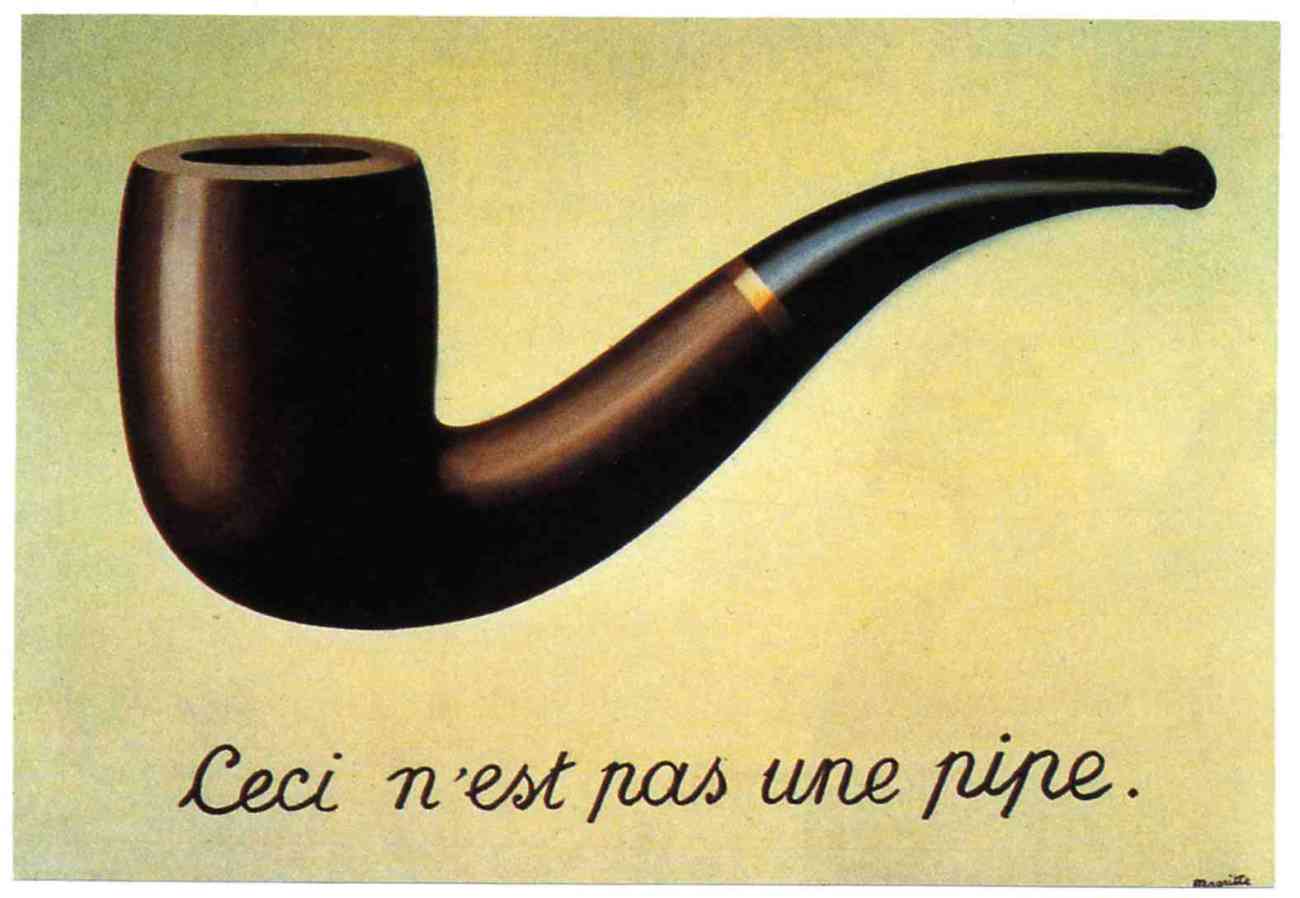
Ceci n'est pas une pipe

R. MAGRITTE, La trahison des images, 1928-29, huile sur toile, Los Angeles county Museum of Art, Los Angeles

                “ An unexamined life is a life not worth living ,” Socrates.

In my Forbidden Books course, we were assigned to develop characters to participate in a Socratic dialogue and record our dialogue on video. In our dialogue, one character is confronted with a dilemma of a philosophical nature. The Socratic Method is based on asking and answering questions that stimulate critical thinking and clarify ideas. This method was invented by Socrates,  an ancient greek philosopher who is known as the father of western philosophy.  
Each students was assigned a theme such as beauty, justice, or love and was instructed to write a socratic dialogue examining the meaning of theme assigned to them. My theme is reality.


Morpheus - played by AJ
Phaedrus -  played by GN


Script:
Morpheus: Hello Phaedrus, how are you today? (Sitting on the courtyard steps.)

Phaedrus: I’m fine, but I am trying to figure something out.

Morpheus: What are you trying to figure out? It seems to me that you have been thinking deeply about something.

Phaedrus: Well, I have been wondering whether you are really there, or if everything I see and do is just in my imagination! Are there really other people, and places, and things to eat, or are they just figments of my imagination? I certainly hope I am real! But it’s a good question. Before we can answer it, though, I think we need to ask, what is reality, and how can we decide whether something is real?

Morpheus: Reality is reality! It is anything that would still be here if there were no one around to experience it.

Phaedrus: Are you implying that we humans do not exist? Are language, consciousness and ideas real? If they are, we must be real, because none of these things would exist without us.

Morpheus: All I know is that we are not simply figments of our imagination. Reality is anything you can touch, see, smell and feel. Something is real if everyone can experience it.

Phaedrus: What about paintings? The tableau itself abides by your definition of reality, but is the image represented on the tableau real? Everyone is able to see, touch and feel the image!

Morpheus: The actual painting is real, but the image represented on it is not.

Phaedrus: Then, what is the difference between a representation of something and the real thing?

Morpheus: A real thing exists in space. It occupies a space.

Phaedrus: Really? What about a mirage?

Morpheus: Mirages are different, they are optical illusions caused by atmospheric conditions. They do not occupy space!

Phaedrus: You are right. Mirages are optical illusions caused by atmospheric conditions. They occur when light rays are refracted and form a false image at the observer’s location. Have you ever heard of Descartes?

Morpheus: Yes. Descartes was a French philosopher and mathematician. He is best known for his philosophical statement saying: “ Je pense, donc je suis; I think therefore I am.”

Phaedrus: Do you agree with that proposition?

Morpheus: I do. Descartes used that proposition to prove that the world exists.

Phaedrus: Is a chair real? A chair cannot think, from my experience. We may be able to think, but how do we know whether or not those ideas are actually ours? And what if someone planted those ideas in our brains, are those ideas still ours? Maybe our brain are pre-programmed, like a robot.

Morpheus: You are right! I cannot answer those question. I was blinded by my own beliefs, and was unable to examine them. You have taught me something. I need to start questioning my beliefs, so that I may defend them better (He said stoutly). You made a great vindication of your ideas.

Sunday, January 19, 2014

The Killer and Crippler - Disease

In my Disease course, we were assigned to research and illustrate the anatomy of our chosen disease, and create a patient profile. My patient profile is a fictional story about a women suffering from polio. The purpose of this action project was to allow our audience to experience what it is like to have polio. I learned about the different effects the polio virus has on the various systems of the body.

Below is my patient story and my illustration:


GN, 2014, Chicago

GN, 2014, Chicago


GN, 2014, Chicago


On the night of November 15, 1950, Melissa, a twenty year old Cape Fear Cotton Mill worker from Fayetteville North Carolina, went to bed with a fever. “This wasn't just any fever,” she would later recall, “My body temperature kept elevating throughout the week.”


Something had been incredibly wrong for nearly a week. Melissa slept sporadically for ten or twelve hours a day. She imaged many causes to explain her symptoms – overwork, flu.

By late November, Melissa an ebullient, gregarious, goal-driven, and energetic women, was exhausted and could barely stand up straight. Melissa felt overwhelmingly tired.

She had been having a little cold, but in November 30, 1950 she began to have trouble breathing and was rushed to the Hospital in Fayetteville. A diagnosis was made, via spinal tap, of Bulgar polio.


She was then whisked away to an isolation ward accepting polio patients. Outside her room, frantic activities took place outside her room. Doctors and nurses were moving about collecting data and writing reports. As she looked from her hospital bed all she saw were dull clouds covering the city. She was quickly placed in a machine designed to do the work of paralyzed muscles. Even with the support of the mechanical caregiver,” Melissa was succumbing to polio. She was whisked to the operating room for an immediate tracheotomy, which helped with breathing. Melissa was given antibiotics and painkillers to reduce her muscle pain and to prevent her from contracting a urinary infection.


Melissa was puzzled by her diagnosis. She had always avoided public free places in fear of contracting this virus. “Polio is terrifying to experience, treat, and observe.” It is an infectious virus. It affects the autonomic nervous system, the part of the nervous system concerned with involuntary jobs, such as digestion, posture, breathing and many more.
The polio is an infectious virus is spread through fecal oral transmission.

It is a viral disease that occurs because of poor hygiene. “Polio is a killer and a crippler that prefers infants and children”. Separated from her family, Melissa endured grueling physical therapy. She faced months of arduous muscle therapy to strengthen weakened muscles in a large wards segregated by age and gender. “I experienced prejudice and discrimination seeking work.” Melissa experienced joint degeneration and skeletal deformities, such as spinal curvature.  


“Because of the poliovirus I would never raise a family or marry, I am a disgrace to my family.” Melissa is now living with post-polio syndrome and its distressing symptoms. Countries with high polio-virus circulation are Southeast Asia, Eastern Mediterranean, and Africa, third world countries. Post- Polio syndrome causes patients to have different symptoms, such as slowly progressive muscle weakening, generalized and muscular fatigue, and muscle atrophy. Post- polio syndrome interferes with an individual’s ability to independently function. Polio causes our respiratory muscles and swallowing muscles to weaken, which can result in troubles breathing and pneumonia (  Robbins, "The History of Polio Vaccine Development.)
Polio was the most feared disease of the twentieth century. It crippled around 35,000 people each year in United States (AMANDA KEHLER, “Poliomyelitis (infantile paralysis). There is no known cure for polio. Vaccination is the only prevention against poliomyelitis. 

Works Cited:


-          AMANDA KEHLER. "Poliomyelitis (infantile Paralysis)." Healthy Hippie. N.p., 26 July 2012. Web. 15 Jan. 2014. <http://www.healthyhippie.net/poliomyelitis-infantile-paralysis/>


-          "Poliomyelitis (infantile Paralysis, Polio)." Poliomyelitis (infantile Paralysis, Polio). N.p., Jan. 2012. Web. 15 Jan. 2014. <http://www.health.ny.gov/diseases/communicable/poliomyelitis/fact_sheet.htm>\
-          David Perlstein, MD, MBA, FAAP, Charles Patrick Davis, MD, PhD. "Polio Symptoms, Causes, Treatment - What Are Signs and Symptoms of Polio? - OnHealth."Onhealth. N.p., 16 Jan. 2014. Web. 20 Jan. 2014. <http://www.onhealth.com/polio/page2.htm>.
-          Paul, J. R. 1971. A History of Poliomyelitis. New Haven: Yale University Press.
-          Robbins, F. C. 1999. "The History of Polio Vaccine Development." In Vaccines, 3rd edition, ed. S. A. Plotkin and W. A. Orenstein. Philadelphia: Saunders.


-          Zuber, P. L. F. 2002. "Poliomyelitis." In Encyclopedia of Public Health, ed. L. Breslow, B. D. Goldstein, L. W. Green, et al., pp. 932-933. New York: Macmillan.

Sunday, November 17, 2013

View Point - An illustration of agricultural

In my food for thought course, we were assigned to create an four panel illustration, representing the four units of our course. The purpose of this action project was to convey our understanding and envision for the future of agriculture through an illustration. I enjoyed working on this action project.
Below is my poster.

Drawing by GN, photo by Tim Reed.


Sunday, November 10, 2013

Can the Dancing Plant Help us Produce More Energy and Fight Crime?

In my Bioneers course, we were assigned to identified a specific plant species and research about it. My chose to research the Codariocalyx motorius.  By isolating unique functions and adaptations, I was able to imagine practical applications for my plant's unique adaptations. I created a poster showcasing what I learned from the plant and how that information can be applied for human purposes. My poster defines bio mimicry  as using nature as an example to innovate human inventions.

Can the Dancing Plant Help us Produce More Energy and Fight Crime?
 
The Codariocalyx motorius, commonly known as the Desmodium gyrans, is a tropical Asian shrub. It’s widely distributed throughout South Asia, and is one of the few plants capable of rapid movement. The Desmodium gyrans is a telegraph plant. It is described in detail in The Power of Movement in Plants, a book written by Charles Darwin and Francis Darwin.

Classification:
Kingdom: Plantae
order: Fabales
Family: Fabaceae
Genus: Codariocalyx
Species: C. motorius

The plant has a useful feature that makes it interesting. The Codariocalyx motorius is famous for its movement of small, lateral leaflets. Each large leaf  is equipped with a hinge that allows it to move, so it can face the sun. Because of the weight of the large leaves, the plant uses lots of energy to move them. Each large leaf has two small lateral leaflets at its base. These small lateral leaflets move constantly along an elliptical path, testing the intensity of sunlight, and directing the large leaf to that area. This is a strategy used by the Desmodium gyrans to maximize its exposure to sunlight by tracking it.

Three things we can learn from this plant:
There are many lessons we can learn from this plant:

a. Working together – trust: Human societies should be built on collaboration/ cooperation. We should recognize our need for help. Nature rewards cooperation. The Desmodium gyrans’ leaves cooperate to take advantage of the best sun.  

b. How small actors can help big ones: The small lateral leaves act as scouts. They test for the intensity of sunlight and direct the larger leaves to it. If it were not for this, the plant would have been wasting its energy.

c. Energy conservation: In order to prevent excessive radiation loss, as an adaptation the Desmodium gyrans has equipped each large leaf with two small lateral leaflets to conserve the plants energy.  We human need to conserve energy. Conserving energy reduces water, air and soil pollution.

You have probably seen calculators with solar cells or surveillance cameras, or wind turbines.
We can apply this plant’s quality to modern problems, including energy generation and public safety.  
a. Solar panels
b. Wind turbines
c. Public security cameras
GN, 2013
Solar panels:
A solar panel captures sunlight and converts it to electricity, much like autotrophs. Plants are able to convert light energy into chemical energy that is used to carry out various cellular metabolic processes. Solar panels turn light into electricity using photovoltaic cells. Sunlight consists of particles called photons. As the photon are absorbed by a solar panel, the photoelectric effect causes the flow of free electrons. A device alters this electricity, enabling it to power electrical items.

Thanks to a new algorithm calculation based on astronomical data, big companies have developed panels with movable mounting that precisely follow the course of the sun. This strategy is used only for large industrial production. My suggestion for smaller applications is to have small panel sensors that will direct the solar panels to the light.

Wind turbines:
Wind turbines or windmills convert wind energy into rotational energy. Wind turbines are controlled by computers. The computer monitors the direction and speed of the wind. The blades are twisted and are connected to a generator. The generator converts the rotational energy into electrical output. Wind turbines rotate clockwise.

Small turbines can be used  instead of the computer to monitor the direction of the wind, so they are locally controlled.

Security camera:
Security cameras are used for crime prevention and evidence. They provide viable images of the perpetrators or criminals. They are placed in high-crime areas to prevent crime and identify criminals. Surveillance cameras provide a sense of security to many. Most security camera are either fixed or move constantly. Small noise and motion detectors can be used to move cameras to events of
interest. This will improve our security/ surveillance system.

                     Works Cited:

  • Darwin, Charles. The Power of Movement in Plants. New York: Da Capo Press, 1966. Print.- 


Friday, November 8, 2013

Rise Up and Take Action - A Freedom song

  In my Global Peace course, we were assigned to research a civil rights leader or any nonviolent leader. I wrote a Freedom Song that highlighted the struggles of Susan B. Anthony and how she overcame them. Also, we were assigned to reflect on our own struggles. The purpose of this action project is to put ourselves into the shoes of a nonviolent leader, and be inspired by their actions.

               san B. Anthony. (2013, November 8). In Wikipedia, The Free Encyclopedia. Retrieved 17:30, November 8, 2013,


FREEDOM FIGHTER:
I wanted to fight against slavery,
Vile, wicked, sinful slavery,
I wanted to speak to the crowds
Who came to abolitionist meetings.
Who, like freedom riders,
Spoke up for the oppressed.
The men said, “It is an abomination
For ladies to speak in public.”
I disagree. I am Susan B. Anthony.

I am strong for the mothers
The wives, and the daughters
I am strong for those profoundly asleep
I am the hinge between freedom and dependence

Once upon a time
A woman could not
Vote
Keep her wages
Own or inherit property
(Unless, like me, she was a “spinster”)
Get a divorce
(Unless her husband wanted one)
Keep her children after a divorce.
I began to fight for women.

I did not live
To see women vote.
But I changed the rest.
The welfare of women
Is the welfare of all.


PERSONAL POEM:
I am caught between worlds.
At home I eat fufu,
And speak French.
At school I eat pizza,
And speak teenager.

I am making a whole
From pieces of two kits.
I learn the lessons
Of my ancestors,
And wear the clothes
Of my descendants.

I am, in myself, diverse.
If I can live with my differences
We can all live
With one another’s differences.
Sarvodaya.

Worked cited: 

Monday, October 21, 2013

Hero's Journey

 In my Stories course, we were assigned to write an analysis for a fictional hero and non-fiction hero based on Joseph Campbell's model of the Hero's journey. We study Joseph Campbell's Monomyth theory. The purpose of this action project was to analyze our heroes and their stories. My analysis is a combination of a presentation and detailed summary. I enjoyed working on this action project.

Below is my written analysis and presentation.


Hero’s Journey


Percy Jackson and the Olympians: The Lightning thief is a fantasy film set in the 21st century. The film borders around the Percy Jackson novel series, by Rick Riordan. In the film, the gods of Mount Olympus and monsters seemed to have walked right out of Percy Jackson’s mythology book and into his life. In the film, Percy is portrayed as a brave and  courageous teenager.

Call to adventure
Unaware of his true identity, Percy is a troubled 16 years with ADHD and dyslexia, with an unique ability to stay underwater for a long period of time. On a field trip to the museum, a fury disguised as Mrs.Dodds attacked Percy and demands for Zeus’s lightning bolt. Zeus’s lightning bolt is the most powerful and devastating weapon. It can destroy mountains and kill Titans.

Mentor/Helper
Percy’s best friend, Grover and Mr. Brunner, his latin teacher helped scare the fury away. Mr.Brunner has Grover take Percy to his mother Sally to Camp half blood. On there way to camp half blood, they are attacked by a minotaur. Percy loses his mother during this battle.

Threshold
By using the minotaur’s horns, Percy was able to kill the minotaur. from all the shock, he fainted. A couples days later, he learned he was the son of Poseidon, that  Mr.Brunner or Chiron was a centaur, and that Grover was a satyr, his protector. Chiron shared all of his knowledge with Percy, and warns him of the danger that lays ahead.

Growth/Skills
Percy began training to use his powers, which include water manipulation and water healing.  After winning a capture the flag game, he received a fiery apparition of his uncle Hades, who reveals that his mother is with him in the underworld. Percy decides to disobey Chiron and go to the underworld. He is accompanied by Annabeth, daughter of Athena and Grover. Luke, son of Hermes provides them with a shield, a pair of winged sneakers, and a map showing the locations of three pearls.

Trials/Challenges
The trio located the first pearl at Medusa's Lair. Percy decapitated her and took her head for later use. The second pearl is in the Parthenon in Nashville. Percy recovers the pearl. However, they are confronted by Hydra. They petrified her by using Medusa’s head. The Third pearl is in the Lotus casino in Las Vegas. Percy, Annabeth, and Grover ate the lotus flower and forgot their purposes. Poseidon spoke in Percy’s mind, which helped him return to his senses. With all of the pearls in their possession, they located the portal to the underworld.

Return
In the underworld, they meet Persephone and Hades. Hades finds the lightning bolt hidden inside Luke’s shield, revealing that Luke was the lightning thief. Because there was only three pearls, Grover volunteered to stay with Persephone, enabling Sally to leave the underworld. The three teleported to the Empire State building, Mount Olympus. Luke attacked Percy.

Revelation/Discarding old self/Accepting the new role
By accepting his identity, he was able to harness the complete power of water. Percy defeated Luke, returned the lightning bolt to Zeus, which allowed Poseidon to briefly speak to his son. The film ends with Percy and Annabeth reunited with Grover and returning to camp Half Blood to continue his training.

 Non-Fictional Hero


Heroes take many forms when we are children, from comic book superheroes such as superman to imaginary friends. As we reach adulthood, our definition of a hero becomes clear, and our heroes become those who we love and admire. Heroes are typically identified with good qualities. Many define heroism as bravery. The dictionary defines bravery as showing no fear.  We are all heroes and have our own heroes. My hero is my mother. My mom has always been the backbone of our family. I have always tried to live through her.


The image above is a comic strip showing six different phases of my hero’s educational paths and struggles.

Call to adventure/Threshold
My mother grew up. My mother grew up in Divenie, a village in the Congo. At the age of 3, she started working in the fields/plantations with her parents. “ I worked 5 hours a day,” she said in her interview with me. She lived in a humbled home. She started school when she was 5 years old. “Going to school was a struggle for me,” she said remorsefully.

Trials/Threshold
My mom, never received the support she needed. “ My parents weren’t able to support me financially or emotionally,” she said. My mom never gave up on her studies. She left the village to go to the city and pursue her dream of becoming a teacher.  She walked about 20 kilometers each day to attend school. My mom was able to support herself financially, by making clothes.

Mentor/Discarding old self/Revelation
Her grandmother supported her emotionally. “ If it wasn’t for my grandmother, I would have lost my mind,” She said lovingly. However, she struggled with keeping up with other students. By her senior year, she got pregnant with her child and stopped going to school. “ Unfortunately, my dream never can true,” She said  mournfully.

Monday, October 7, 2013

4 MILLION YEARS IN 25 SLIDES - Evolution

In my population course, we created a presentation providing evolutionary context for the organism of our choice. By mapping its migration over time, we identified the origin of our chosen organism. Also, we studied our organisms, compiled and graphed pieces of species - specific data. The purpose of this action project was to provide historical context for the organism studied. I enjoyed working on this action project. Below is my presentation, and a document with information on my experiment!